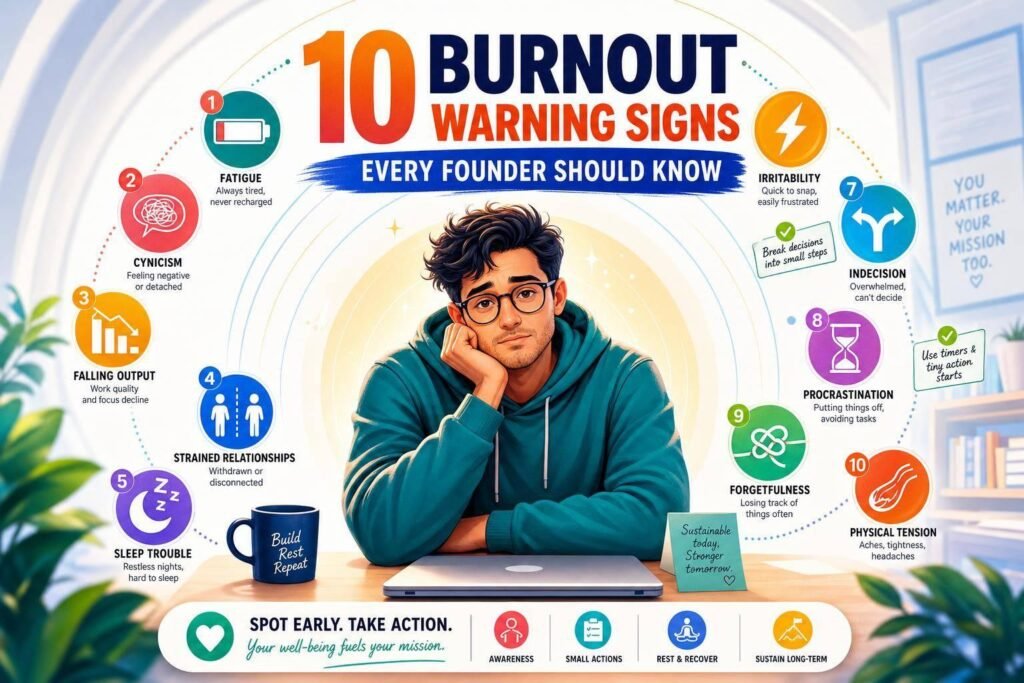
More than 50% of founders said they dealt with burnout in the past year, and 73% said they hide it. If I were reading this as a founder, I’d want the short version fast: burnout usually shows up as constant fatigue, lower drive, cynicism, worse focus, strained relationships, body stress, and feeling stuck in the company I built.
Here’s the core idea in plain English: stress usually fades after rest; burnout doesn’t. If sleep, a weekend off, or a short break no longer helps, that’s a warning sign. And if I start dodging hard decisions, snapping at people, losing interest in wins, or waking up tired after 8 hours of sleep, I’d treat that as a capacity problem, not a character flaw.
The 10 warning signs covered here are:
- feeling drained even after rest
- a drop in motivation and confidence
- more cynicism, irritability, or numbness
- working more but getting less done
- dreading work even on good days
- slipping focus and weaker decision-making
- tension in work relationships
- pulling away from friends and hobbies
- headaches, poor sleep, and other body signals
- feeling trapped by my own company
What I’d do first:
- delegate one decision
- cancel one low-value meeting
- protect one block of no-notification work time
- set one hard stop for the workday
- track these signs once a week
Quick Comparison
| Pattern | Normal stress | Burnout |
|---|---|---|
| Energy | Tired, then better after rest | Tired even after rest |
| Mood | Annoyed by short-term problems | Ongoing cynicism or numbness |
| Focus | Busy but still clear enough | Foggy thinking and delayed decisions |
| Motivation | Pressure, but still some drive | Dread, avoidance, flat wins |
| Recovery | Weekend helps | Time off does not help much |
If I saw myself in more than a few of these signs, I’d act early. Small changes now can stop a much bigger crash later.
sbb-itb-7c1dd7e
Why Founders Miss Burnout Early On
Burnout almost never shows up with a big warning sign. It tends to hide behind ambition instead. The founder replying in Slack at midnight or jumping on late-night Zoom calls may label it commitment or grit. And startup culture doesn’t help. It often treats exhaustion like proof that you’re doing things right, which is one big reason the early signs slip by for so long.
Burnout usually doesn’t look like a dramatic collapse, either. It can wear the mask of discipline, ambition, and resilience.
Stress is temporary. It tends to ease once the pressure lets up. Burnout sticks around, even after the sprint ends. If a full night’s sleep or a few days off doesn’t change how you feel, that’s a sign worth taking seriously.
For many founders, the hard part isn’t just the strain. It’s the silence around it. You can’t tell investors you’re struggling. You can’t tell your team without wondering whether it’ll shake their confidence. So you act like everything’s fine while running on empty. According to a 2025 survey, 73% of founders hide their burnout from others, often because the pressure to project constant progress never lets up.
Those quiet shifts are the warning signs to look at next.
1. You Feel Drained Even After Rest
You sleep eight hours, take the weekend off, and still wake up drained on Monday. When that keeps happening, the issue usually goes deeper than sleep.
Founders often live in a constant state of alert. Decisions pile up. Deadlines keep coming. Responsibility never quite lets go. Over time, burnout can keep your body stuck in that mode, which means rest stops doing its job. In many cases, the problem is structural: too many decisions, weak routines, or work that never fully ends.
If fatigue feels like your default setting, the issue is often the system around your work, not sleep alone.
Three small actions worth trying right now:
- List today’s decisions and mark which ones you can hand off. Decision overload is one of the fastest ways to keep exhaustion going.
- Protect one anchor routine. A steady wake-up time or a screen-free hour before bed can help your recovery without changing your whole schedule.
- Add one short recovery break. A 10-minute walk or a few minutes away from screens can reset your focus during the day.
If rest no longer resets you, the next warning sign is a drop in motivation.
2. Your Motivation and Confidence Take a Sudden Dip
Closing a funding round or signing a big client doesn’t hit the way it used to. Instead of feeling proud or energized, you get a short burst of relief. Then your mind jumps straight to the next problem.
That kind of emotional flatness is one of the clearest early signs of burnout. In many cases, it shows up before founders even call it burnout.
When wins stop feeling like wins, something’s off. Decisions that used to take a few minutes can start to feel heavy. You may catch yourself hiding in email, Slack, and other reactive tasks just to avoid the higher-stakes work that matters most, like product, fundraising, or hiring.
Confidence can slip too. You start second-guessing pricing, hiring criteria, or market positioning, even if those were areas where you once felt steady. During burnout, this often happens when your sense of self gets tangled up with company metrics. A bad quarter stops feeling like a business problem and starts feeling personal.
Raj Sankarlall, founder coach, says burnout dulls strategic thinking, judgment, and creative problem-solving.
Three small actions to try right now:
- List the decisions you’re avoiding because you no longer trust your judgment. Once you name them, they’re easier to deal with.
- Write down one win so you actually register it instead of rushing past it.
- Cut low-value work and focus on the few tasks that move the business.
When motivation drops, irritability and numbness often show up next.
3. You Feel More Cynical, Irritable, or Numb
At some point, the mission can start to feel flat. Instead of thinking about how to work smart, not hard, you may catch yourself thinking about leaving. For a lot of founders, that shift first shows up as irritability.
A missed deadline or a lukewarm note from an investor can suddenly feel much bigger than it is. In meetings, you may get sharper with feedback and less willing to sit with other people’s ideas. That’s often a sign you’re stretched too far.
"Cynicism is the most subtle early-stage burnout signal, and the most lethal. Founders are the belief engine of their company. When your belief erodes – even slightly – your team feels it before you admit it."
- Raj Sankarlall, Founder Coach
There’s also a quieter version of this: emotional numbness. You’re still doing the work, but you don’t feel much while doing it. Joe Nemmers, a therapist, puts it this way:
"Emotional numbing is a shutdown response. Our brain shuts down as a protective response to keep us safe when our nervous system is overloaded."
- Joe Nemmers, Therapist
You might still show up to calls, close deals, and answer emails. On the surface, things can look fine. But conversations with your team may start to feel more like box-checking than actual connection, and empathy can get harder to reach. That gap starts to show up in how you lead and how you work with other people.
If that sounds familiar, try a few small moves right away:
- Name the feeling. Say it plainly: irritated, detached, resentful, drained.
- Cancel one nonessential meeting or task. Give yourself a little room.
- Set a firm end time for your workday and stick to it four days a week.
When this keeps going, output usually drops.
4. You Work More but Get Less Done
When burnout gets worse, the issue isn’t effort. It’s output. You’re putting in more hours, but your to-do list barely moves. That gap between how much you work and how little gets finished is one of the clearest signs that burnout is creeping in.
Burnout slows your thinking. Decisions take longer, feel fuzzier, and become easier to put off. The mental skills behind judgment and planning start to slip. Something that once took five minutes can drag on for an hour. You read the same Slack message three times and still don’t know how to answer.
It also shifts how founders use their time. When your brain is drained, it pulls you toward reactive work. You spend the day in Slack, email, and status calls while the work that matters most sits untouched. So you end up with fewer real decisions and a lot more surface-level motion.
Here’s a simple way to push back: at the end of the day, do a quick decision audit. Note which calls had to come from you and which ones someone else could handle. Hand off the rest. Then protect 90 minutes every morning for your highest-value work.
If this sounds familiar, it helps to look at how burnout differs from normal founder stress.
5. You Dread Work Even on Good Days
You wake up already pushing against work, even when the business looks fine on paper. That’s a burnout warning sign, not just a bad mood. And when that feeling sticks around, it often turns into avoidance.
A lot of the time, dread shows up before the workday even begins. You open Slack, email, or your calendar and feel resistance right away. That numb, flat feeling is emotional shutdown: you can still function, but the work no longer feels like it means much. A slump comes and goes. Dread hangs around.
Researchers call this hidden burnout, where you look functional while feeling emptied out. The founder still joins calls, answers messages, and knocks out surface-level tasks, but puts off the work that matters most. That kind of avoidance can slow product, fundraising, and hiring long before anyone puts the burnout label on it.
A simple place to start: drop or hand off one small task. Then do a weekly check-in and write down the tasks you keep dodging. Pick one and remove it from your plate. Sometimes one less task is enough to give you some room to think again.
If dread starts slowing your thinking and pushing decisions back, the next warning sign is slipping focus.
6. Your Focus and Decision-Making Are Slipping
After dread, focus is often the next thing to go.
Burnout can show up as small mental slips at first. You reread the same message twice. You forget a task you were sure you’d remember. You lose your train of thought halfway through a sentence. That isn’t laziness. It’s burnout.
Then decision fatigue kicks in. It may start with minor choices, but it doesn’t stay there. Before long, it spills into bigger calls like pricing, hiring, and positioning. When that keeps happening, your best work window gets smaller, and the choices that matter most keep getting delayed. Chronic sleep deprivation, a common burnout symptom, can cut decision-making ability by up to 50%. On top of that, 72% of startup founders say stress directly affects how they make decisions.
"Cognitive clutter begins with small lapses in focus that are easy to brush off. You reread messages and still miss details, forget tasks unless they are written down, or struggle to stay with one line of thinking long enough to finish it." – Rosalind Toews
A simple way to spot the pattern is to look at yesterday’s decisions. Which ones needed you, and which ones didn’t? Hand off what you can, especially around pricing, hiring, roadmap, and positioning. Then protect 90 minutes every morning for your highest-value work. No meetings. No notifications. Just space to think.
It also helps to turn repeat decisions into written defaults or short playbooks. That way, your brain isn’t burning energy on the same problem again and again.
When this starts changing how you deal with people, the next warning sign is strained relationships.
7. Work Relationships Feel Strained
When burnout starts changing your reactions, it also changes how other people experience you. And that usually shows up fast in your work relationships.
It often comes through in tone, timing, and trust. Co-founders notice the short replies. Teams notice when you seem less present. A co-founder may see you getting short-temed over small issues, and your team may notice you faking enthusiasm in meetings or pitches.
That’s where things can turn into a rough loop: a small setback feels personal, you overreact, you regret it, and then it happens again.
The hard part is that these shifts can chip away at trust before the numbers on a dashboard change. Team culture often starts to fray early. Founder cynicism can quietly affect how you communicate and how much your team trusts your judgment, and that damage can take 12–18 months to reverse after you recover. High-performing employees are often the first to spot the gap between what you say and how you show up.
If this sounds familiar, say it out loud to someone you trust. Tell a co-founder or mentor you think burnout is affecting your reactions. And if you snapped at someone, apologize fast.
If work is pulling you away from people outside the company, the next warning sign is withdrawal from friends and personal interests.
8. You Pull Away From Friends and Personal Interests
As burnout builds, even simple social plans can feel like work. You cancel dinner, ignore texts, and let hobbies drift. That can happen during a busy week. But when it keeps going after the deadline passes, it usually points to something more than a packed calendar.
For a lot of founders, self-worth gets tangled up with how the company is doing. When that happens, anything outside the business can start to feel like wasted time. That makes it easier to pull back. And since 73% of founders hide their burnout from others, that sense of isolation can grow fast.
The tough part is that this kind of shutdown can make time off feel dull instead of helpful. You step away, but you don’t feel better.
A small step is often enough to start. Try one low-pressure coffee or a short call. Block off open time on your calendar for non-work activities. And if you can, tell one person you trust what you’ve been noticing. Saying it out loud is often the first step.
If this withdrawal starts showing up with poor sleep, headaches, or constant tension, your body may be sending burnout signals too.
9. Your Body Is Sending Clear Distress Signals
When burnout moves past mood and motivation, it starts showing up in the body. In many cases, the body sounds the alarm before the mind fully catches up.
Watch for signs like chronic headaches, migraines, neck and shoulder tension, digestive problems, and broken sleep. That can look like waking up at 3:00 AM with your mind racing, or getting a full night of sleep and still feeling wiped out. At that point, rest isn’t doing its job anymore.
Other red flags include:
- relying more on caffeine, sugar, or late-night stimulants
- getting sick more often
- staying sick longer than usual
If those symptoms don’t ease up after rest, burnout is more likely than just a rough week.
A simple way to check in with yourself: rate your physical energy from 1 to 10 each week and watch the pattern over time. If symptoms last for several weeks or start getting worse, scale back and get professional help.
If the pressure starts to feel inescapable, the next warning sign is feeling trapped by your own company.
10. You Feel Trapped by Your Own Company
When the physical warning signs keep stacking up, burnout can start to hit at a deeper level. One of the clearest signs is this: your company feels like a trap instead of a choice. What used to feel meaningful now feels like a weight you can’t put down.
Your mind shifts too. Instead of thinking about the next goal, you keep picturing escape – quitting, getting a normal job, or just disappearing for a while. That move from building to escaping is a serious red flag.
A big reason for this is identity blur. When you stop seeing a line between yourself and the company, every business problem starts to feel personal. A rough week isn’t just a rough week anymore – it feels like a verdict on you. And when the company seems to need you for every call, that’s usually a systems issue, not a personal failure.
As therapist Annie Wright, LMFT, puts it:
"When you cannot tell where you end and the company begins, every business problem is also a personal crisis."
One practical move: do a decision audit. Write down the choices that land on your desk each day. Then sort that list into what you can delegate, defer, or drop this week.
How to Act on Each Warning Sign
If one or more of the 10 signs sounds familiar, take the next steps to ease the strain without blowing up your week. Use this framework when exhaustion, cynicism, focus loss, or dread starts showing up at work. You do not need a full reset. Start small. Then repeat what helps.
Use the Same Pattern for Every Sign
Burnout comes from load, not weakness. If your usable workday has shrunk, treat it like a capacity issue, not a motivation issue. That shift matters.
The fastest way to respond is simple: match each warning sign to one work habit you can change this week. Not five. Just one. That keeps the fix grounded in daily work instead of turning it into another project to manage.
Keep Examples Tied to Startup Work
Keep the examples rooted in the workday, not vague self-help talk. Think missed Slack details, snapping in 1:1s, avoiding board prep, or putting off hiring and pricing calls. That level of detail helps. Once you can name the pattern, picking a fix gets a lot easier.
Start With Small, Doable Actions
Mindfulness coach Trish Tutton puts it plainly:
"Burnout prevention starts with teaching people how to regulate stress in real time, not just offering perks when they’re already exhausted."
Pick one fix for each sign. Use the 80/20 rule: focus on the 20% of work that drives 80% of results. Block uninterrupted time on your calendar for strategic work. Turn off all notifications during those blocks. Set a hard stop time at least four days a week. Turn one recurring task into a standard process or automation. Track one weekly question: what drained you most?
Burnout vs. Normal Founder Stress
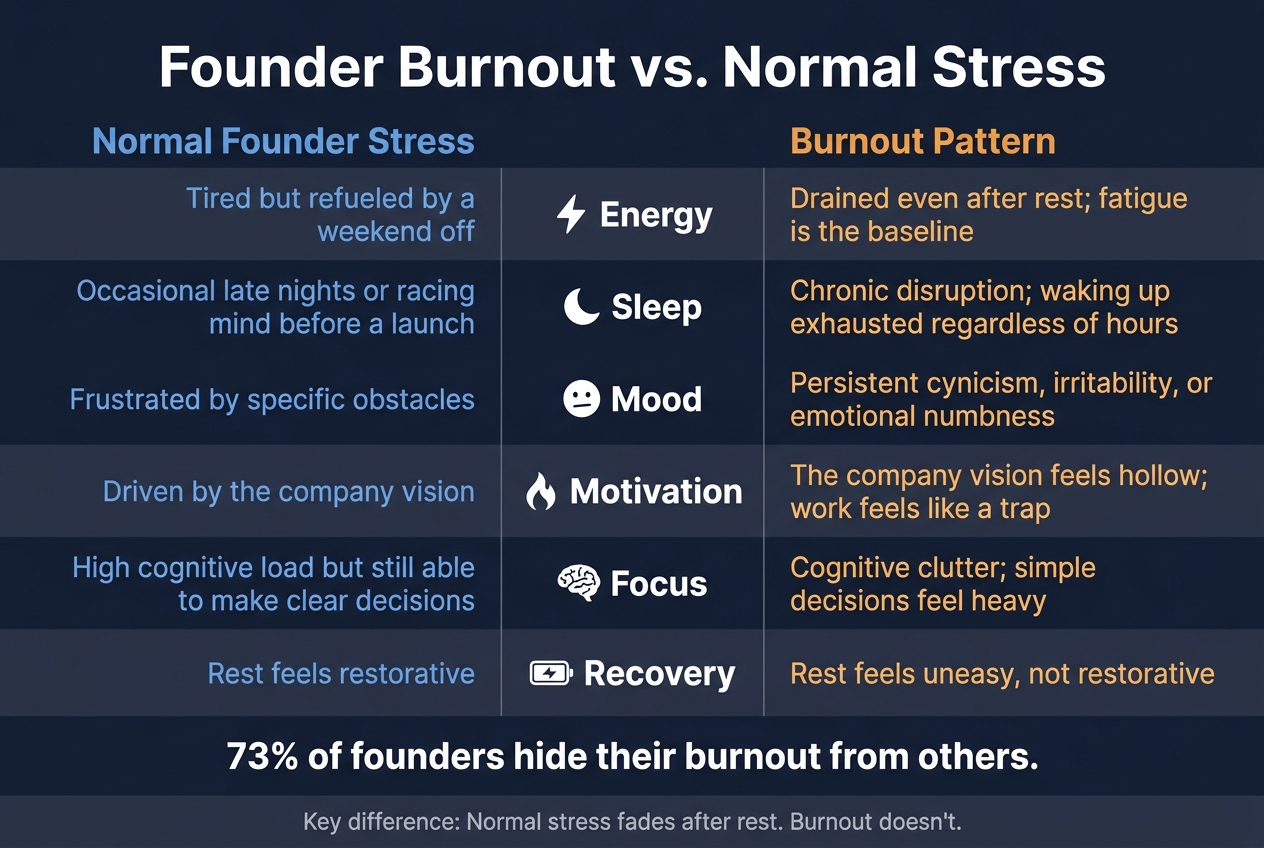
Founder Burnout vs. Normal Stress: Key Differences at a Glance
The main difference comes down to recovery.
Normal stress tends to ease when the pressure comes off. After a product launch, a board deadline, or a fundraising sprint, you usually start to feel like yourself again once that stretch is over.
Burnout doesn’t work that way. It sticks around after the sprint ends. And that’s what makes it different: rest stops helping.
A rough day here and there doesn’t mean much on its own. What matters is the pattern. Are you just in a hard week, or has this become your default setting?
| Dimension | Normal Founder Stress | Burnout Pattern |
|---|---|---|
| Energy | Tired but refueled by a weekend off | Drained even after rest; fatigue is the baseline |
| Sleep | Occasional late nights or racing mind before a launch | Chronic disruption; waking up exhausted regardless of hours |
| Mood | Frustrated by specific obstacles | Persistent cynicism, irritability, or emotional numbness |
| Motivation | Driven by the company vision | The company vision feels hollow; work feels trapped |
| Focus | High cognitive load but still able to make clear decisions | Cognitive clutter; simple decisions feel heavy |
| Recovery | Rest feels restorative | Rest feels uneasy, not restorative |
Look at the table and be honest with yourself. If most of your answers land in the right column, that’s not just a bad stretch. It’s a pattern that deserves attention.
A Simple Weekly Burnout Check-In for Founders
Once you know the signs, the next move is to track them every week. Spotting burnout is helpful. Tracking it weekly helps you catch it earlier – in about 5 minutes.
Rate Each of the 10 Signs Once a Week
Give each of the 10 warning signs a score from 1 to 5. A 1 means “not an issue,” and a 5 means “this is hitting hard right now.” The point is to make your internal state easier to see, so you can notice week-to-week shifts before they snowball.
Track a Few Basic Inputs Alongside Your Ratings
Your ratings show the symptom. These inputs show the pressure behind it. Each week, track four simple numbers: how many hours you sleep each night, your total work hours for the week, how many days you exercised, and how much caffeine you needed to get through the day.
| Input | What to Track | Red Flag |
|---|---|---|
| Sleep | Nightly hours + morning energy | Waking up exhausted after 8 hours |
| Work Hours | Total weekly hours | Working 70+ hours while revenue or metrics remain flat |
| Caffeine | Daily cups or servings | Increasing intake as a sign you’re compensating for exhaustion |
| Exercise | Days per week with movement | Consistently canceling workouts due to lack of time |
Look for Patterns, Not Just One Bad Day
Block 5 minutes on Friday afternoon or Sunday evening for a quick review. One bad week can just be noise. But if your scores keep sliding for several weeks, that’s the signal to pay attention.
Conclusion
Burnout rarely hits like a lightning bolt. It creeps in, bit by bit, until the warning signs are too loud to brush off. For founders, the habit of always pushing forward can make those signs feel like nothing more than a rough week.
But the damage goes beyond stress or mood. Burnout weakens the very things founders lean on most: strategic thinking, judgment, and problem-solving.
So don’t treat those signals like personal failure. Treat them like capacity warnings. That’s why the next move doesn’t need to be dramatic. It just needs to be small and immediate.
Founder cynicism can erode team trust and take months to unwind.
Start with one simple step today:
- Protect your sleep
- Delegate one decision
- Cancel one meeting
- Set one boundary
Your company needs your best thinking, not whatever you have left in the tank. Act early, protect your capacity, and catch burnout before it digs in – so you protect both yourself and the business.
FAQs
How do I know if it’s burnout or just a hard week?
The main difference comes down to whether the symptoms are short-term or stick around.
A hard week is usually tied to a rough stretch at work or life. Once the pressure lets up, or you get a bit of time off, you tend to bounce back. Burnout, on the other hand, is chronic exhaustion that can keep going even after rest.
If fatigue, irritability, or low motivation don’t ease up after a break or a lighter workload, burnout is more likely. The key is to watch for patterns, not just one bad day.
When should I get professional help for burnout?
Consider getting outside help if burnout symptoms stick around for more than a few weeks. Working with a therapist, coach, or consultant who understands entrepreneurship can be a smart investment in your resilience, not a sign of weakness.
Even setting up an appointment for a later date can ease some of the pressure. It puts support on your calendar, which can make things feel a little less heavy.
What’s the first change I should make if several signs feel familiar?
First, be honest about what’s going on. Burnout feeds on denial, so simply naming the symptoms to a trusted peer, mentor, coach, or partner is a solid first step.
Then make one small, manageable change instead of trying to fix your whole life in a single swing. That could mean canceling one meeting, handing off one task, setting one clear boundary, or putting sleep and physical regulation first.