
Almost half of the time, our minds drift. One study cited in the article puts mind-wandering at 47%, and that lost attention adds up fast at work.
If I had to sum up the whole guide in a few lines, it would be this: workplace mindfulness is not about long meditation sessions or doing less work. It’s about using short pauses during the day to lower stress, protect focus, and cut down on mental drag. The article shows how to do that with small habits before meetings, between tasks, during deep work, and at the end of the day.
Here’s the full takeaway in simple terms:
- Mindfulness at work happens in the middle of the day, not just in meditation sessions.
- Short screen-free resets help more than doom-scrolling between meetings.
- Stress hurts judgment, focus, and output when it sticks around too long.
- Context switching leaves attention behind, which can drain energy and lead to more mistakes.
- Simple tools work best: breathing resets, body scans, sensory checks, mindful listening, and short walks.
- A steady rhythm matters: start the day with intent, protect focus blocks, and end with a shutdown routine.
- Team habits matter too: leaders set the tone, meetings are a good place to start, and practice needs protected time.
- Mindfulness is not a fix for bad workloads or understaffing. It helps people notice strain early and recover better under pressure.
A few of the most useful examples from the article:
- Box breathing: inhale 4, hold 4, exhale 4, hold 4
- 4-4-6 breathing: inhale 4, hold 4, exhale 6
- 3-3-3 sensory check: notice 3 things you see, 3 you hear, and 3 you can touch
- 30-second meeting arrival: feet on the floor, full exhale, one clear intention
- End-of-day reset: write down what’s done, list tomorrow’s open tasks, then close work down on purpose
The big idea is simple: small resets done every day can help you stay clear-headed without slowing your work down.
Below, I’ll keep the same plainspoken tone and walk through the guide’s main points without repeating it line by line.
How to Practice Mindfulness at Work: Stress Reduction Exercises
sbb-itb-7c1dd7e
Core Mindfulness Practices That Fit Into a Real Workday
Workplace Mindfulness Practices: Quick Reference Guide
Mindfulness works best at work when it acts like a short reset, not one more thing on your to-do list. Think small: a breathing pattern before a tense call, a body check after an hour at your desk, or a quick stretch when screen fatigue starts to hit. These short practices can lower stress while helping you stay on task. The simplest approach is to match the practice to the moment.
Breathing Resets, Body Awareness, and Desk-Based Regulation
Clenched jaws, hunched shoulders, and shallow breathing are useful signals. They tell you it’s time to pause before stress piles up.
Two breathing techniques work well during the workday:
- Box breathing (inhale for 4 counts, hold for 4, exhale for 4, hold for 4) helps before tense meetings or high-pressure moments.
- The 4-4-6 pattern (inhale for 4, hold for 4, exhale for 6) can lower arousal and ease tension in about 1 minute.
If your attention starts bouncing all over the place, try the 3-3-3 sensory check. Notice three things you can see, three sounds you can hear, and three objects you can touch. It takes less than a minute.
A seated body scan is also a good fit for desk work. Move your attention from your head down to your feet. Pause at common tension spots like your jaw, neck, and shoulders, and breathe into those areas. Even 3 minutes can help you spot and let go of strain from a long stretch in front of a screen.
Mindful Transitions, Meetings, and Communication
The space between tasks or meetings is easy to waste. It’s also one of the best times for a reset. Instead of rushing straight into the next thing, take three slow breaths and check in with your jaw and shoulders. That short pause can clear some of the mental residue from the last task.
Before you walk into a meeting or join a video call, use the 30-second arrival practice: put both feet on the floor, exhale fully, and set one simple intention, such as "listen first."
The same move helps with written communication. Before replying to a stressful Slack message or email, read it once for content. Then read it again for the tone you’re projecting onto it. Take one full breath before you type.
In standups, sprint planning, or one-on-ones, mindful listening means giving the other person your full attention instead of writing your reply in your head while they’re still talking. That’s a small shift, but it can stop minor mix-ups from turning into rework.
Mindful Breaks and Movement During Long Screen-Heavy Workdays
Regular micro-breaks improve productivity.
A short walk or a few minutes of stretching can help too. For remote or hybrid workers, a brief walk or stretch before or after work can create a cleaner shift between work and home. And if you can’t step outside, desk-friendly movement still helps. Shoulder rolls, a neck stretch, or a quick stand-and-look-away break can take the edge off screen fatigue.
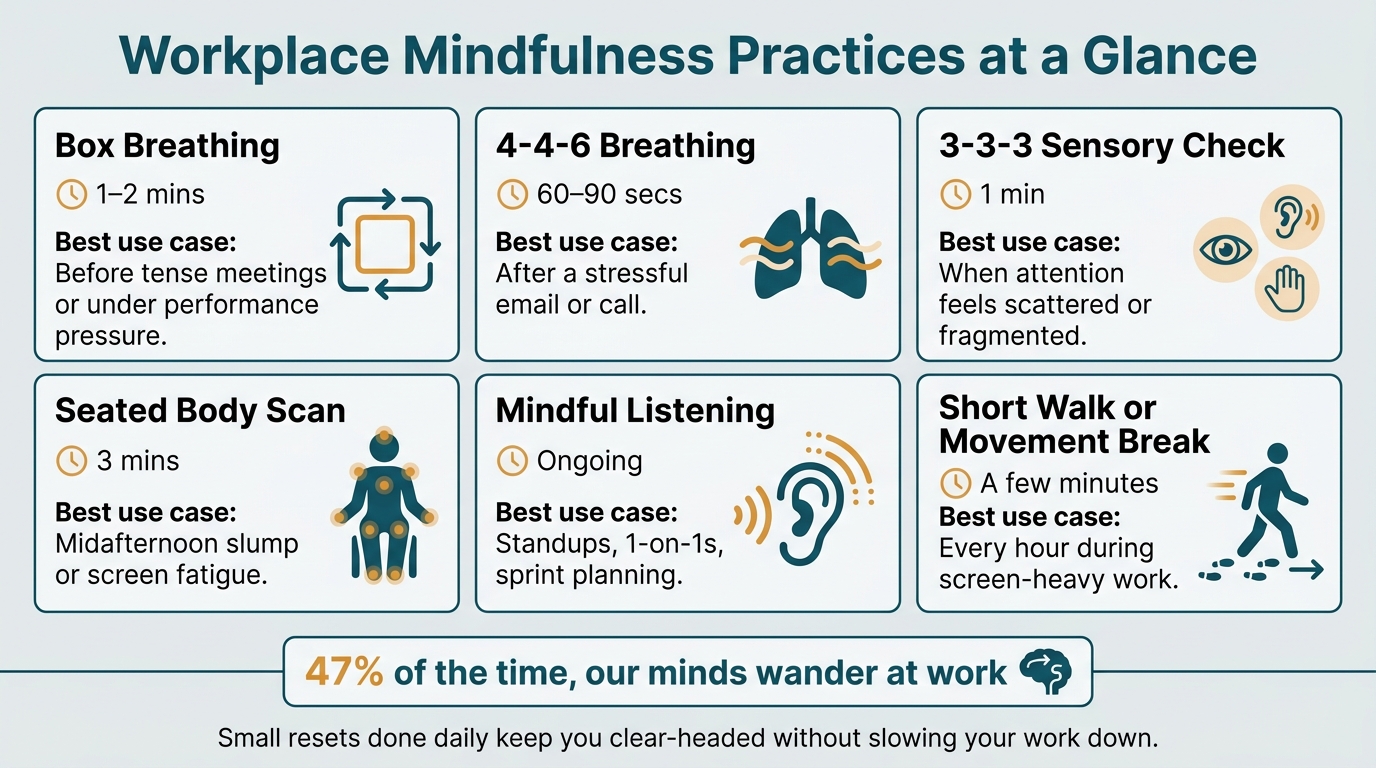
Use the right tool for the right moment, whether that’s tension, distraction, meetings, or too much screen time.
| Practice | Duration | Best Use |
|---|---|---|
| Box Breathing | 1–2 mins | Before tense meetings or under performance pressure |
| 4-4-6 Breathing | 60–90 secs | After a stressful email or call |
| 3-3-3 Sensory Check | 1 min | When attention feels scattered or fragmented |
| Seated Body Scan | 3 mins | Midafternoon slump or screen fatigue |
| Mindful Listening | Ongoing | Standups, 1-on-1s, sprint planning |
| Short Walk or Movement Break | A few minutes | Every hour during screen-heavy work |
Next, turn these micro-practices into a workday rhythm that protects focus.
How to Build a Mindful Workday for Steady Productivity
Micro-practices tend to stick when they fit into a workday you can count on. Without that structure, mindfulness often stays stuck at the "I should do that" stage instead of becoming part of how you work. The aim is simple: begin with focus, guard your deep work time, and end the day cleanly. Start with the first hour, because it shapes everything that comes after.
Morning Setup, Deep Work Blocks, and Managing Digital Distractions
Before you open your laptop or check Slack, stop for two minutes. Take three slow breaths and ask yourself, "What matters most today?" For remote founders and team leads who don’t get that built-in commute, a small substitute can help – a short walk or a quiet coffee ritual before you sit down can do the same job. It tells your brain that work mode is starting.
Then begin your first deep work block with your tabs closed and notifications turned off. Stay with one task for 25–45 minutes. If you feel the urge to jump to something else, treat that moment as a cue to pause, ask "What am I here to do?", and come back to the task in front of you. You’re not trying to fight the impulse. You’re noticing it, then returning to your work. That same habit matters later, too, when it’s time to stop work instead of letting it drift into the evening.
End-of-Day Shutdown Rituals and Recovery Boundaries
A clean finish matters just as much as a focused start. Spend five minutes wrapping up the day: write down what you finished, list tomorrow’s open tasks, and shut work down in a physical way – close your tabs, shut the laptop, or do a quick stretch. That small review gives your mind a chance to let go of the open loops it might otherwise keep replaying in the background all evening.
Pairing Mindfulness with Productivity Systems Using the Work Smart, Not Hard Approach
Mindfulness doesn’t replace a solid productivity system. It helps your current system work better. When you’re more aware of your energy and attention, it’s easier to decide when deep work should happen, which meetings need pushback, and how much room you actually have on a given day. Work Smart, Not Hard pairs these mindfulness practices with practical frameworks for managing your workload without burning out – it’s a practical next step.
Building Mindfulness into Team Culture and High-Stress Work
Individual habits help, but they have limits. Under pressure, people fall back on whatever the team has made normal. That’s why mindfulness needs a place in shared routines, not just personal to-do lists.
Leadership Support, Team Rituals, and Program Rollout
Teams copy what leaders do. If a founder multitasks in meetings, everyone else reads that as the rule. On the flip side, small visible actions send a clear message: close your laptop during a discussion, pause before responding to bad news, and protect your own recovery time. Your team notices all of it.
A good place to begin is meetings, because that’s where team habits show up in plain sight.
Use a 60-second silent arrival before important meetings. It can lower reactivity and help people settle in with better focus.
A few ground rules make this easier to stick with:
- Keep participation voluntary.
- Protect time for practice.
- For skeptical tech teams, frame it as mental fitness, not wellness.
Measuring Results and Choosing the Right Implementation Model
If you want to know whether this is working, track a few simple markers: stress, recovery speed, focus quality, meeting effectiveness, sick leave, and retention.
The right format depends on how your team works and how much time people can spare.
| Format | Best For | Time Investment |
|---|---|---|
| In-person MBSR | Structured team building | High (8 weeks) |
| Online course | Remote/distributed teams | Moderate |
| Micro-practices | High-pressure, limited-time environments | Very low (1–3 minutes) |
| Hybrid model | Depth + convenience | Moderate |
| App-only | Self-directed learners | Low |
One point matters here: manager support by itself doesn’t do much. People are more likely to use mindfulness when the company backs it with protected time and flexible scheduling.
Using Mindfulness During Outages, Investor Pressure, and Founder Burnout
This is where these habits earn their keep.
A production outage or a rough investor meeting can keep the body keyed up long after the event ends. Three slow breaths or a short walk without your phone can act as a post-event reset. It’s a small move, but it can stop one bad stretch from bleeding into the rest of the day.
Burnout tends to show up in three ways: exhaustion, cynicism, and lower effectiveness. Mindfulness won’t solve chronic understaffing or impossible deadlines. And if it’s used only as a way to squeeze more work out of tired people, that’s a problem. Used every day, though, it can help founders and team leads notice the warning signs before they hit the wall.
Conclusion: Make Mindfulness a Daily Work Habit
Workplace mindfulness is a daily reset that helps protect focus when pressure starts to build. The payoff comes from small, steady resets, not the occasional long session.
Those short pauses can stop stress before it piles up. That makes it easier to get back to the task in front of you and keep a clear head through the day.
Key Takeaways for Founders and Small Tech Teams
Use the same pattern from the guide: start, transition, end.
That can look like a two-minute morning intention before you open your inbox, three slow breaths between meetings, or a five-minute closing ritual to review what you finished and write down what’s still open. Simple works.
These habits tend to last when you connect them to routines you already have, like:
- waiting for your laptop to boot
- pouring your first coffee
- walking to your next meeting
What matters most is consistency, not complexity.
Next Step: Pick One Practice and One Team Habit to Start This Week
Choose one personal reset and one team ritual – like 30 seconds of silence at the start of your next meeting – and try them for a week. That’s how mindfulness starts to become part of the way your team works.
Work Smart, Not Hard shares time management, focus, and mental health strategies for tech entrepreneurs to help you build from there.
FAQs
How quickly can workplace mindfulness start helping?
Workplace mindfulness can start to help in as little as one minute with simple practices like a “Minute-to-Arrive” ritual.
With steady practice, small shifts – like calmer reactions and better focus – may start to show up within the first week or two.
What if I keep forgetting to pause during the day?
If you keep forgetting to pause, add small transition rituals on purpose. Stress tends to pile up in the space between tasks or meetings, so a brief reset can make the habit stick.
That can be as simple as standing up for 1 minute, stepping away from your screen, or taking a two-breath pause before you start the next task. You can also use reminders or cues to make these pauses happen more often and with less effort.
Can mindfulness still help if my workload is too high?
Yes. Mindfulness can still help when your workload is too high.
Short practices can support recovery, self-awareness, and emotional regulation. Even a brief pause in the middle of a packed day can help you slow down, notice what’s happening, and respond with a little more control instead of running on autopilot.
That said, mindfulness on its own won’t fix chronic overload. If the work itself is too much, no breathing exercise can solve that by itself. It tends to work best when paired with healthy workload management, clear priorities, and realistic expectations.