Entrepreneur burnout is often a support problem, not just a workload problem. When pressure stays high and support stays low, stress turns into poor decisions, isolation, and health issues. Research discussed by Harvard Business Review describes executive loneliness as a burden tied to leadership and high-stakes decision-making, especially during a crisis.
If I had to boil this article down into a few plain points, it would be this:
- Burnout builds when demands outrun support
- Loneliness makes founder stress worse
- No one person should carry every support role
- Founders need four kinds of help: emotional, informational, task-sharing, and honest feedback
- Support works best when it is scheduled before things go wrong
- Small warning signs like irritability, poor sleep, and decision paralysis should trigger action early
Here’s the simple idea: I don’t prevent burnout only by working less or using better systems. I lower the risk by making sure I have the right people around me for the right problems. That can mean a peer group, a mentor, a therapist, a co-founder, or a trusted friend.
A few facts from the article make the case fast:
- More than 150,000 publicly reported tech layoffs were tracked in 2025
- 77% of founders in a cited wellbeing report did not seek professional help
- 54% reported high stress in the same report
- 81% reported masking fears, challenges, and stress
What I like about this piece is that it keeps the answer simple: build support like part of the business. Put it on the calendar. Review it often. Fix weak spots early. That way, burnout is less likely to turn from a personal strain into a company problem.
The rest of the article explains what burnout looks like, which support groups matter most, and how to set up a support system that stays in place when stress climbs.
Avoiding Burnout By Building Community with Rob Tracz | Ep 303
sbb-itb-7c1dd7e
The burnout problem tech entrepreneurs face
Burnout is more than plain fatigue. It’s a mix of exhaustion, cynicism, and lower effectiveness. It tends to build when founder pressure moves faster than the support around it. Usually, the first signs show up in how founders think, make calls, and deal with other people.
How burnout shows up in daily founder work
At first, it can look almost harmless. You lose focus. Routine choices take longer than they should. You drift into busywork because it gives you a sense of control. Those are early signs that the support around you isn’t enough.
Then the people side starts to crack. A founder may snap at teammates in meetings, pull away from the team, or feel numb about work that used to matter. Sleep stops fixing the problem, and feeling drained starts to seem normal. From there, many founders keep working on empty and start treating survival mode like standard output.
Why startup conditions make burnout worse
Startup life makes this worse because founders rarely do just one job. In a single day, someone might ship a product update, manage cash runway, and answer investor concerns. That kind of role-switching leaves no breathing room.
The always-on pace adds even more strain. Every Slack message can feel urgent. On top of that, many founders tie their self-worth to company performance. A bad week at work starts to feel personal. Many also keep their struggle hidden because they worry it will look like weakness – and one founder wellbeing report found that 77% did not seek professional help.
That’s why social support matters so much. It lightens the load, helps founders see things more clearly, and keeps isolation from piling on.
What happens when burnout goes unchecked
If no one steps in, burnout stops being just a personal issue. It turns into a business issue too.
Decision quality is often the first thing to slip. Burned-out founders go with the easiest option instead of the best one. They put off hard conversations. They hide bad news from the team. Then, when that bad news finally comes out, it hits everyone at once.
The company slows down too. Burned-out founders stop building and start maintaining, not because they want to, but because they don’t have the mental energy to do more. As Violetta Bonenkamp puts it plainly: "When the nervous system is overloaded, the company starts making stupid moves". Over time, the health cost adds up as well – insomnia, emotional numbness, and a bad quarter that feels like a personal failure.
The next step is understanding which kinds of support interrupt that spiral before it hardens into burnout.
Why social support lowers burnout risk

The 4 Types of Social Support That Prevent Founder Burnout
Support lowers burnout risk because it spreads pressure across more than one person. When a founder is overloaded, judgment slips and costly mistakes can stay hidden. That’s why support matters more than motivation or time management alone.
Instead of forcing one person to carry everything, a support network takes on part of the mental and emotional weight. Regular check-ins help stop stress from piling up until it breaks something.
Founders also spend a lot of energy in public-facing settings like investor updates and social media, where confidence is part of the job. A support network gives them a private place to say what’s actually going on without putting their reputation at risk. Even a short, honest conversation can ease a major hidden drain on mental energy.
"Loneliness is not just a private emotion. It shapes judgment, risk tolerance, conflict style, hiring choices, and even whether a founder keeps going when things get ugly." – Violetta Bonenkamp, Mean CEO
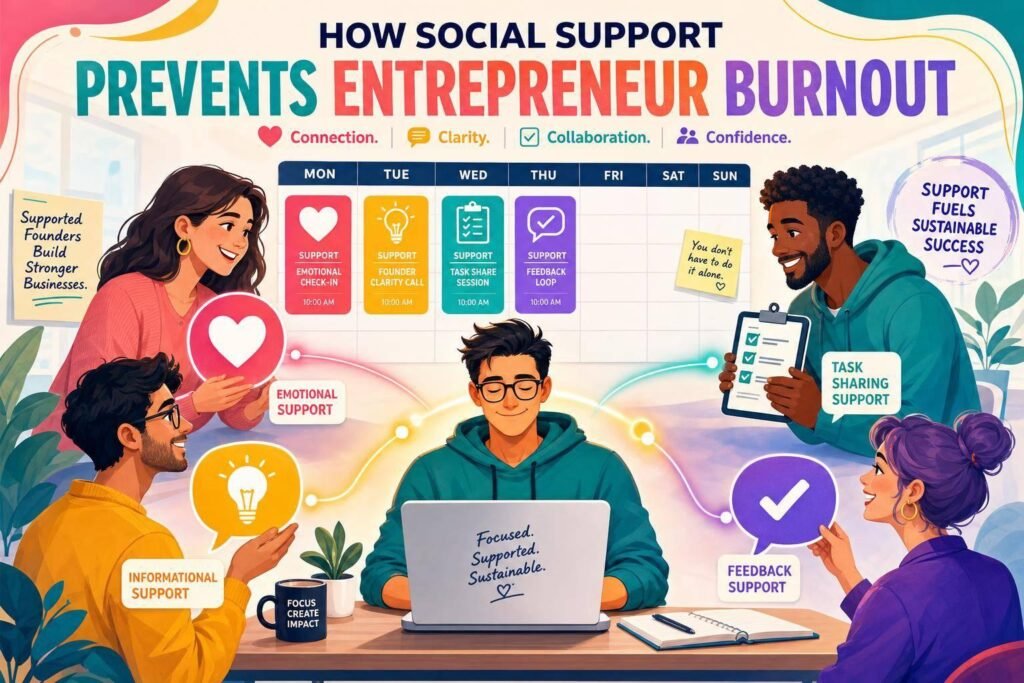
The four types of support founders need
Not all support helps in the same way. Different kinds of pressure call for different kinds of help. Here’s how the four support types that matter most for tech founders lower burnout risk.
| Type of Social Support | What it looks like for tech entrepreneurs | How it reduces burnout risk |
|---|---|---|
| Emotional | A therapist or peers who allow radical honesty about fear and shame | Reduces the energy drain of masking and helps prevent emotional exhaustion |
| Informational | Mentors or founders giving feedback on hiring, pricing, or fundraising | Cuts decision fatigue and helps founders avoid mistakes made in isolation |
| Instrumental | Operators or specialists handling legal, finance, or product tasks | Reduces overload by sharing day-to-day responsibilities |
| Feedback | Accountability groups that challenge assumptions and call out blind spots | Keeps setbacks in perspective and helps steady confidence after a bad quarter |
These support types only work when actual people and clear roles fill them.
Don’t expect one person to cover all four. Leaning on a spouse or co-founder for emotional support, strategy input, and accountability all at once puts too much strain on one relationship and still leaves gaps in the network.
How support counters overload and isolation
Each type of support addresses a different burnout driver. Emotional support helps with the exhaustion that comes from carrying fear alone. Informational support lowers decision fatigue by giving founders a sounding board for high-stakes calls. Instrumental support deals with raw overload by moving specialized tasks off the founder’s plate. Feedback support, often through peer mastermind groups of 4 to 8 members, helps founders keep setbacks in perspective and stops confidence from cratering after a bad quarter.
Isolation already shapes founder decisions every day. Social support won’t solve every problem, but it narrows the gap between pressure and the help a founder can reach in time.
Next, map these needs to the inner circle, peer founders, mentors, team support, and professional care that can meet them.
The support networks that matter most
Not all support does the same job. When pressure hits, it helps to turn to different people for different things: emotional grounding, honest feedback, strategy, day-to-day help, and clinical care. The goal is simple: match each type of strain with the right kind of support.
Inner circle, peer founders, and mentors
Your inner circle – close family or friends – helps you stay grounded. They remind you that your worth is bigger than this quarter, this launch, or this company. That separation matters. Without it, company performance can start to feel like personal value.
Peer founder groups help in a different way. They make it easier to stop masking and speak plainly. A small group of 5–8 noncompeting founders meeting every other week can become a place where people say what’s actually going on instead of acting like everything is under control. That kind of honesty lowers the pressure that often drives burnout.
Mentors and advisors help with decision fatigue. They’ve seen patterns before, can spot weak points early, and offer outside perspective. That often helps founders make better calls with less drag.
Team support and professional mental health care
Support can’t live only outside the company. It needs a place inside the business too. A trusted co-founder or senior operator can notice when systems are starting to crack, push back on your thinking before problems grow, and make room for blunt feedback. That’s often what makes delegation possible.
A founder wellbeing report found that 54% experienced high stress and 81% masked fears, challenges, and stress. Peer support helps with perspective and the sense that you’re not the only one dealing with this. Therapy or coaching serves a different role. It helps founders work through persistent anxiety, shame, or exhaustion. And that support works best before stress is already high, not after.
"Your co-founder should not be your therapist. Your therapist should not be your market validator." – Violetta Bonenkamp, Mean CEO
Where Work Smart, Not Hard fits in your support network

Sometimes a founder doesn’t need a deep conversation. They need a fast, practical answer. In those moments, a trusted resource can take some weight off daily decisions. Work Smart, Not Hard fits that role. If you need quick guidance on time management, tools, or sales and marketing decisions, it gives you fast access to practical judgment without leaning on your human support network.
| Support Network | Primary Benefit | Best for Which Burnout Symptoms |
|---|---|---|
| Family/Friends | Emotional support & identity stability | Identity isolation, feeling unseen |
| Founder Peers | Honest space & shared understanding | Performance fatigue, masking stress |
| Mentors | Faster, better decisions | Decision fatigue, blind spots |
| Internal Team | Delegation & operational reality checks | Overload, heroics culture |
| Therapy/Coaching | Processing anxiety, shame, exhaustion | Persistent anxiety, chronic exhaustion |
| Practical Guidance | Quick, informational support | Decision overload, lack of frameworks |
How to build, maintain, and review your support network
Schedule support like any other business priority
Build support before burnout hits. This isn’t a backup plan. It’s part of how you run the business.
When pressure climbs and support doesn’t, performance slips. That’s why the job is to close that gap on a set schedule, not scramble once things are already on fire. Put emotional, informational, instrumental, and feedback support on the calendar and treat each one like part of the operating system.
A workable weekly rhythm for a U.S.-based founder might look like this:
- A 30–60 minute check-in every Friday
- A biweekly peer founder call
- A monthly therapy or coaching session
- A quarterly strategy review
These blocks should be handled like any other must-keep business priority.
"Your C-suite is accountable for business results. Your board is accountable for governance and returns. Your personal support team is accountable for you." – Lonely Entrepreneur
If you’re starting from scratch, build the Friday check-in first. Keep it simple: write down your toughest moment, one decision you avoided, and one ask for next week.
For support at home, get specific. Define what a bad week looks like. Also decide which issues need a planned conversation instead of a late-night emotional spillover.
The point is simple: use these support types as a calendar, not just an idea.
Use simple tools and boundaries to keep support consistent
This doesn’t need a fancy setup. A calendar block, a private Slack or WhatsApp thread with a small peer group, and a recurring Zoom link can do the job. Simple tools often work best because they’re easy to keep using when life gets messy.
What matters more is the boundary around them. Protect support blocks the same way you’d protect deep work. Turn on Do Not Disturb. Decline meetings that collide with them. Don’t let "quick syncs" eat up time meant for recovery.
A monthly audit can also help. Look at who gives you emotional safety, who gives you straight strategic feedback, who helps with accountability, and where you’re still carrying too much alone.
| System or Routine | Primary Tool or Resource | Burnout-Related Benefit |
|---|---|---|
| Weekly Founder Check-in | Notes app or private journal | Spots energy drains before they compound |
| Peer Mastermind Circle | Private Slack/WhatsApp + Zoom | Reduces isolation; creates an honest space |
| Recovery Blocks | Calendar time-blocking | Protects cognitive function and prevents decision fatigue |
| Blunt-feedback 1:1s | Scheduled recurring meeting | Adds honest dissent |
Once support is scheduled and protected, it stops resting on willpower alone.
Track warning signs and adjust early
A support network can look fine on paper and still stop helping. If you never review it, weak spots creep in quietly.
That’s why a simple Friday check-in matters. Track a few signals: energy, sleep quality, motivation, irritability, and focus. You don’t need a giant system. You just need enough signal to notice when something’s off.
When more than one warning sign shows up in the same week, take that as your cue to adjust. The fix doesn’t need to be huge. One extra peer call, one delegated task, or one hard conversation moved into a more honest setting can change the direction fast.
| Warning Sign | Likely Underlying Issue | Recommended Support Adjustment |
|---|---|---|
| Decision paralysis | Decision fatigue or isolation | Schedule a strategic debrief with a mentor or peer group |
| Irritability with team | Nervous system overload | Delegate 20–30% of tasks; enforce recovery blocks |
| False confidence | Identity isolation or fear of judgment | Move a performance interaction to an honest space |
| Hiding bad news from stakeholders | Performance pressure or shame | Access a peer call to normalize the setback |
| Physical symptoms (insomnia, headaches) | Chronic stress or systemic overload | Seek professional medical or mental health support |
There’s one more safeguard worth adding. Give a trusted ally – a co-founder, senior operator, partner, or close friend – a short list of your personal burnout signals. Then give them clear permission to call it out when they see the pattern. That short warning list can catch trouble before it snowballs.
"If your support system depends on luck, charisma, or one ‘trusted person,’ it is not a system. It is a gamble." – Violetta Bonenkamp, Founder, Mean CEO
Those signals tell you when the network needs more support before burnout gets worse.
Evidence, sources, and scope
This guide combines practical founder routines with research and industry reporting. Useful starting points include Harvard Business Review on CEO loneliness, the Investing in Wellbeing founder report, Layoffs.fyi’s 2025 tracker, and peer-reviewed research on occupational loneliness and burnout among SME owners.
Health note: This article is educational and is not a diagnosis or a substitute for professional care. Persistent exhaustion, insomnia, anxiety, or loss of functioning deserves support from a qualified health professional. Seek urgent local help if you or someone else may be in immediate danger.
Conclusion: Treat social support as a burnout-prevention system
Those warning signs all point to the same thing: too much pressure and too little support. Founder burnout is usually a support problem, not just a workload problem.
The answer has to be built on purpose. A support network gives founders honest spaces – peer calls, therapy sessions, and trusted mentors – where they can think clearly without putting on a show. Build all four layers – emotional, informational, instrumental, and feedback – so no single person has to hold the whole weight. The goal isn’t more motivation. It’s less isolation and faster access to help.
Burnout signals a weak support system, not a character flaw.
Key actions for busy founders
Use the same support map you built above to turn this into a repeatable routine. Start with a blunt audit: who do you call when things go sideways, and which type of support does each person cover? Any gap you find is a place where you’re still carrying the problem alone.
Then put a small peer circle in place – 4–8 non-competitive founders – and set a recurring cadence that gets reviewed monthly. Share your personal burnout signals – irritability, insomnia, decision fatigue – with at least one trusted ally who has permission to call them out. Treat those time blocks like a board meeting.
Review your support network the same way you review runway, cash, or hiring priorities. It should be part of your operating system, set up before pressure spikes and checked before warning signs start piling up.
A strong support system is the burnout-prevention system founders need.
FAQs
How do I know if I’m burning out or just tired?
You may be dealing with burnout, not just plain tiredness, if you feel emotionally drained for a long stretch, get irritable more often, struggle to make decisions, notice physical issues like headaches or insomnia, and lose interest in things outside of work.
The big difference is duration. These signs tend to stick around for weeks and often get worse even after rest.
Who should be in a founder support network?
A founder support network should include:
- Trusted peers who understand entrepreneurship
- Mentors or advisors with industry expertise
- Mental health professionals, such as therapists or coaches
- Family or close friends who provide emotional support
Together, these relationships give founders practical guidance and emotional grounding.
How can I build support if I have little time?
Building support with limited time is possible if you take small, deliberate steps. Start by looking at the network you already have. Then, over the next 30 days, add one peer, one professional support option, and one recovery habit.
Keep it simple so it sticks. That might mean biweekly or monthly check-ins, recurring 20-minute calls with trusted peers or mentors, or a weekly routine like a "CEO dial-down" or a quick support brief.
Continue with a complete guide
For a connected framework, explore our sustainable founder performance guide. Turn the framework into action with the 30-day founder support network checklist. Then continue with delegation strategies that reduce founder burnout.
Related Blog Posts
- 10 Productivity Tips for Tech Founders to Beat Burnout
- “Master Your Focus: Tech-Driven Methods to Work Smarter in 2025”
- How Startup CEOs Avoid Burnout with Delegation
- Ultimate Guide to Workplace Mindfulness
When peer support is not enough
Peer support can reduce isolation and help with perspective, but it is not a substitute for professional care. Consider speaking with a qualified health professional when stress, low mood, anxiety, sleep problems or exhaustion persist, worsen, or interfere with daily functioning.
- Use trusted people for practical help and early check-ins.
- Use a licensed professional for assessment, treatment and confidential clinical guidance.
- If there is immediate danger or a risk of self-harm, contact local emergency services or a crisis service in your country now.
The World Health Organization’s guidance on mental health at work is a useful starting point for understanding workplace risks and support. This article is educational and does not provide a diagnosis.