Burnout recovery is not just rest. It usually means cutting workload, setting hard limits, and changing how the company depends on you. In these founder stories, people hit a wall with panic attacks, sleep problems, brain fog, or total loss of drive. And the fix was rarely a vacation alone.
Here’s the short version:
- Burnout often built slowly, even while the business looked fine from the outside.
- 34% of founders report burnout, and 72% face mental health strain.
- The first relief usually came from stepping back fast: deleting work apps, taking leave, blocking off mornings, or getting therapy.
- Recovery lasted when founders handed off work, set role limits, cut hours, and rebuilt their routines.
- A common problem was founder dependency: the company leaned too much on one person.
- Another big issue was identity: when the business did badly, the founder felt like they were failing too.
If I had to sum up the article in one line, it would be this: burnout sticks around when the work setup stays the same, and it fades when the setup changes.
A few patterns stood out fast:
- Warning signs: bad sleep, dread, panic, focus problems, overreaction, numbness
- Fast actions: time off, no Slack, no email, therapy, health blocks, distance from work
- Long-term fixes: delegation, fewer direct reports, lower hours, better routines, clearer roles
- Outcomes: some founders cut from 80+ hours a week to 20–30, changed business models, or left one role for a better fit
Entrepreneur Burnout Is Real (How I Escaped It While Running Multiple Businesses)
sbb-itb-7c1dd7e
Quick comparison
| Founder | Main trigger | First move | Long-term shift | Result |
|---|---|---|---|---|
| Brian Balfour | Sleep issues, pressure | Deleted work apps | Built life around sleep and training | Returned with more clarity |
| Terry Tateossian | Health crisis, team load | Protected 6:00 a.m.–10:00 a.m. | Smaller business, stricter role lines | Better health and more control |
| Jason Long | 80+ hour weeks, crash, money stress | Sold most possessions and left the city | Process-driven company setup | Down to 20–30 hours/week |
| Joel Gascoigne | Loss of drive | Took 6 weeks off and logged out | More support and distance from always-on work | Got space to recover |
| Chris Ducker | Heavy workload, health crash | Medical leave | No-work Fridays and quarterly resets | Better health and steadier pace |
| Yaro Starak | No support system | Started building a team | Delegation across five roles | More time for deep work |
So if you’re reading this as a founder, the takeaway is simple: don’t just ask how to rest. Ask what has to change so you don’t end up here again.
Burnout Recovery Patterns Across Entrepreneurs
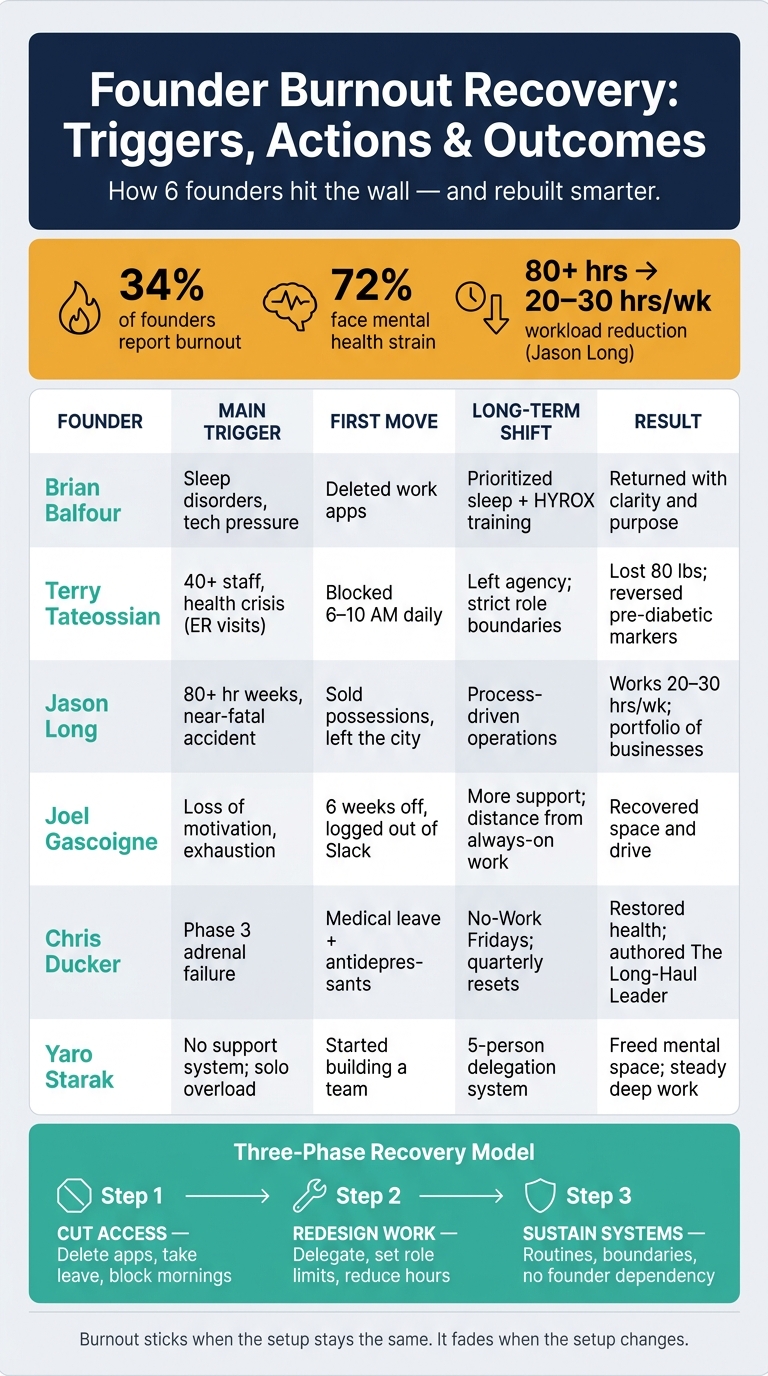
Founder Burnout Recovery: Triggers, Actions & Outcomes
How Founders Recognized the Breaking Point
Burnout didn’t hit all at once. It crept in.
What started as irritability and bad sleep turned into fatigue, back pain, panic attacks, and brain fog. In Terry Tateossian’s case, full-blown panic attacks sent her to the ER with chest pains. Brian Balfour was diagnosed with sleep disorders before he fully admitted something was seriously wrong.
The mental toll showed up just as often. Founders talked about brain fog, trouble focusing, and overreacting to small problems, like a slow client reply. Even simple decisions started to feel draining. Then came the emotional weight: dread around opening the laptop and losing interest in work that used to matter. At that point, pushing through wasn’t an option anymore.
"One day I woke up and couldn’t bring myself to sit in front of the computer. It’s hard to explain until you experience it. But I told my wife, ‘I feel broken.’" – Brian Balfour, CEO, Reforge
What Stepping Back Actually Looked Like
When founders finally made a change, the first steps were often blunt and immediate.
Balfour deleted work apps from his phone to break the always-on cycle. Tateossian blocked 6:00 a.m. to 10:00 a.m. for her health and kept that time off-limits before touching work. Jason Long, after a near-fatal car accident and stress-related heart issues, left the city and sold everything except essentials.
The pattern here is hard to miss: they didn’t just trim work hours. They cut access. That distance from constant notifications and demands gave them space to rethink how work fit into their lives.
How Recovery Moved from Rest to Redesign
Rest helped, but it didn’t last unless the business stopped depending so heavily on the founder.
Tateossian moved from running a 40-person digital agency to a coaching practice and retreat business with a team of eight. She also put clear roles in place so staff couldn’t skip managers and go straight to her. Long shifted from a "visionary" style to a more structured operator approach and used financial modeling to cut down on uncertainty. Balfour rebuilt his leadership approach around health tracking and regular training as part of his routine.
That’s the part that stands out: recovery wasn’t just about stepping away. It meant changing the setup that caused the problem in the first place. Those shifts made a difference, but they still didn’t erase the deeper causes overnight.
Why Burnout Took Hold
These recovery stories only make sense once you see the pressure sitting underneath them.
Work-Life Imbalance and Always-On Work Habits
Work and personal life blurred into one long stretch of late nights, weekends, and constant metric checks. For a lot of founders, work becomes the default answer to anxiety. It feels like control when everything else feels shaky. But there’s a cost. Energy drains faster than it comes back, and after a while, exhaustion starts to feel normal.
Jeff Boyd built MTE on a relentless “say yes” mindset.
"From the outside, I looked like I was in my prime. Internally, I was just fried." – Jeff Boyd, Co-founder, MTE
Over-Commitment, Founder Dependency, and Emotional Load
Saying yes to everything can look like drive at the start. Later, it turns into a structural problem. When founders carry every key decision across sales, product, and customer support, the business starts leaning on them too heavily.
Freja ran a $144,000-a-year SaaS business on 70+ hours a week for three years, with 20 hours spent on customer support alone. That’s a clear sign the burnout was built into the model, not just caused by a bad week or two.
There’s also the emotional side of it. Many founders hide stress from teams, investors, and family. On paper, they’re still functioning. In private, they’re carrying the weight alone, and that isolation gets heavier over time.
Financial Pressure and Identity Tied to the Business
Financial stress can make even a small setback feel huge. Talha Asif, founder of a $1 million agency, spent four years in a state of constant fear. One unanswered client proposal could feel, in his mind, like the start of total business failure and personal ruin. Even after the business was stable, that fear kept him stuck in survival mode.
Then there’s identity. When the business becomes how a founder sees themselves, any setback lands harder. Xaver Lehmann sold his AI startup for $60 million and still fell into depression afterward. The money didn’t fill the gap left by losing the thing he had built and treated like his “baby”.
That’s why the next fixes weren’t just about taking a break. The real issue was load.
Recovery Moves That Changed the Outcome
Immediate Steps: Cutting Workload, Resting, and Getting Support
The first thing that brought relief was simple: stop the work from following you everywhere.
Joel Gascoigne did exactly that. He took six weeks off, logged out of Slack, handed things over in a memo, and rested
"I lost motivation. I just didn’t care. I knew I cared deeply, but I had nothing left. I couldn’t get up in the morning." – Joel Gascoigne, Founder & CEO, Buffer
Brian Balfour ran into a similar breaking point. He got to a stage where he couldn’t even sit in front of his computer, so during his break, he disconnected from work completely Gascoigne also saw a therapist every three weeks
That time away mattered. But it helped because it opened up space to change how the company worked day to day.
Longer-Term Changes: Boundaries, Delegation, and Redesigned Roles
Rest can give someone breathing room. It doesn’t fix the root problem by itself.
What made recovery last was changing the setup behind the stress.
After her own mental health crisis, Shani Godwin, CEO of Communiqué USA, put in place a formal "Joy Economics" framework. She banned emails after 7:00 p.m. and on weekends, linked compliance to performance reviews, and took five fully offline weeks away from the office. Her company kept growing with a 14-person team
Terry Tateossian, after two ER visits for panic attacks, blocked off 6:00 a.m. to 10:00 a.m. for health and set firmer role boundaries
Chris Ducker, founder of Youpreneur, put in a strict No Work Friday rule and quarterly resets after being diagnosed with phase 3 adrenal failure in 2021
The through line isn’t hard to see: recovery held up when the founder stopped being the automatic fix for every problem.
Where Practical Tools Fit Into Recovery
These stories land on the same point. Personal recovery needs backup from changes in how the business runs.
For founders trying to rebuild after burnout, tools that help with time management and workload control can make those changes stick. Work Smart, Not Hard is built for that job, with practical guidance on handling mental load and building work habits that tech entrepreneurs can keep up over time.
What Made Recovery Last
Support Systems and Operating Changes That Prevented Relapse
Recovery lasted when founders changed how the business ran, not just how their calendar looked.
Jason Long cut his workload from 80+ hours a week to 20–30 hours by putting systems in place so the business no longer relied on him for every call. Yaro Starak built a five-person delegation setup – an executive assistant for email, a second assistant for onboarding, a website manager, a copywriter, and a video editor – so he could spend his time on deep work and content creation.
Those fixes took pressure off day-to-day work. After that came a harder shift: letting go of the idea that the founder had to be the default source of stability.
Blakely Graham described lasting recovery as a leadership choice, not a personal indulgence.
"You have to invest in yourself. People want your leadership, so don’t feel guilty about it." – Blakely Graham, Co-founder, TaskRay
What kept recovery in place was structural change: clearer roles, less founder dependency, and work that fit both the company’s stage and the founder’s actual capacity.
Comparison Table: Triggers, Recovery Actions, and Outcomes
The same pattern shows up in each case: a trigger, some immediate relief, then a deeper operating shift that changed the result over time.
| Entrepreneur | Burnout Triggers | Earliest Recovery Actions | Long-Term Changes | Outcome |
|---|---|---|---|---|
| Blakely Graham | 10 years of growth, co-founder conflict, loneliness | Nature walks, gym, therapy | Sold company; moved into advisory and podcasting | $10 million ARR exit; now helps other founders |
| Brian Balfour | Tech downturn pressure, sleep disorders | Deleted work apps; disconnected from work | Prioritized sleep; HYROX training; work-to-life transitions | Returned to Reforge with clearer vision and purpose |
| Chris Ducker | Phase 3 adrenal failure; pandemic-era workload, busywork trap | Medical leave; antidepressants; one-month break | No-work Fridays; quarterly retreats; deep work first | Restored health; authored The Long-Haul Leader |
| Terry Tateossian | Managing 40+ staff, people-pleasing, health crisis | 6–10 AM personal routine; fitness coach; Peloton | Left agency; built virtual coaching with strict boundaries | Lost 80 lbs; reversed pre-diabetic markers; sustained fulfillment |
| Jason Long | 80-hour weeks, near-fatal car accident, 2008 crash | Sold everything; moved cities; started over | Process-based operations; budget-driven management | Works 20–30 hours/week; runs portfolio of businesses |
| Yaro Starak | No support system; working every day of a vacation | Recognized the problem; started building a team | 5-person delegation system; focused on deep work and content creation | Freed up mental space; steady content creation |
Conclusion: Practical Lessons for Tech Entrepreneurs
These stories all point in the same direction: burnout doesn’t happen in one dramatic moment, and recovery doesn’t either. It builds through overload, founder dependency, and weak boundaries. It stays away only when those conditions change.
The first steps still matter. Founders often need to cut back, rest, and get support. But recovery that lasts comes from changing the way work is set up, not just stepping away for a week or two. For tech entrepreneurs, that means putting recovery on the calendar first, handing off the work that drains them, and building systems that don’t need constant founder availability.
Resources like Work Smart, Not Hard focus on that exact shift – helping founders put time management, mental health, and smarter workflows into practice before burnout forces their hand.
FAQs
How do I know if I’m burned out or just tired?
Fatigue usually passes. A break, a day off, or a little extra sleep can help you bounce back and feel like yourself again.
Burnout is different. It goes deeper. It shows up as long-term exhaustion that doesn’t go away with rest. It often comes with cynicism, emotional distance, and the feeling that what you’re doing isn’t working.
You may be dealing with burnout if you feel stuck, your sense of meaning has faded, or your business model only works when you’re ALWAYS there to keep it moving.
Why doesn’t a vacation fix founder burnout?
A vacation usually doesn’t fix founder burnout because burnout is rarely just about being tired. In a lot of cases, the problem runs deeper.
For many founders, burnout is tied to structural and psychological issues. Maybe your sense of self gets wrapped up in how the company is doing. Maybe your day-to-day role no longer fits your values, your strengths, or the kind of work you actually want to do. That’s where things start to feel heavy.
A short break can help you rest. It might even give you a little breathing room. But it doesn’t change the patterns that keep the stress machine running, like overwork, constant pressure, a hair-trigger stress response, or weak support around you.
So while time off can help at the surface level, it usually doesn’t fix the root of chronic stress.
What should I change at work to keep burnout from coming back?
Treat recovery as a non-negotiable part of your business strategy. Set clear work boundaries, turn off notifications after hours, and block recovery time on your calendar before anything else gets added.
Step away from the always-on grind by handing off draining tasks, automating repeat work, and spending more time on what you do best. It also helps to have support in your corner, whether that’s a peer group or a coach, along with steady habits like movement, time outside, and mindfulness.