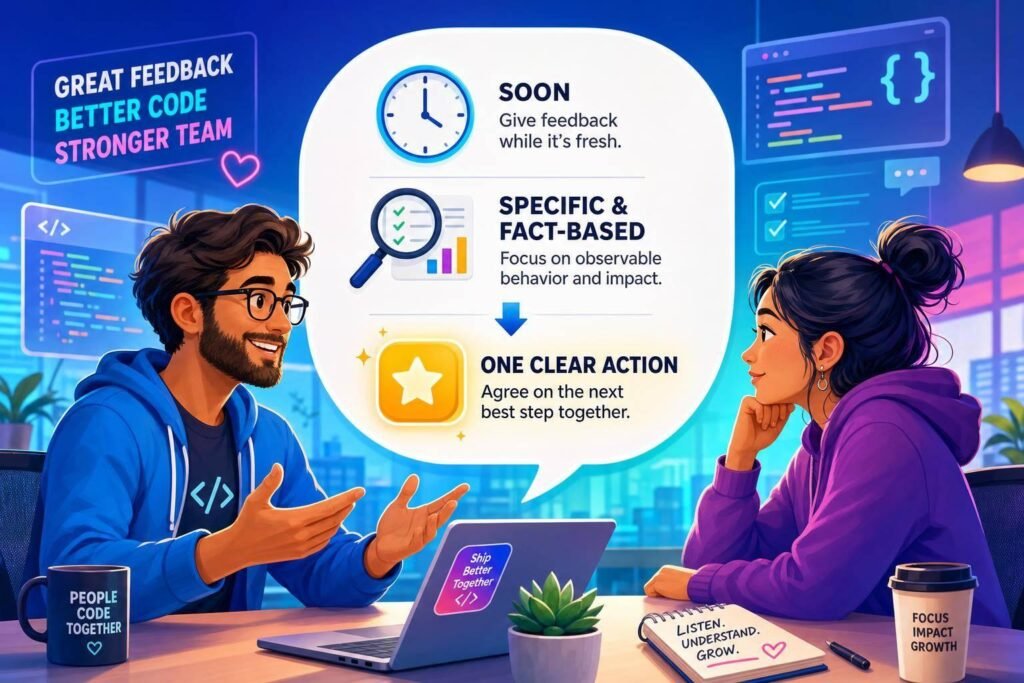
Bad feedback slows teams down. Good feedback fixes problems early, cuts rework, and helps people improve without guesswork. In tech teams, the best approach is simple: say it soon, make it specific, keep it tied to what happened, and end with one clear next step.
I’d boil the whole article down to this:
- Use the right kind of feedback: positive, constructive, corrective, behavioral, or growth-focused
- Check three things first: should this be said, should I say it, and should I say it now?
- Use a simple structure like SBI: situation, behavior, impact
- Match the setting to the message: public for praise, private for sensitive issues
- Build feedback into daily work: PRs, 1:1s, retros, standups, and postmortems
- Follow up with one action, one owner, and one check-in date
- Keep the balance right: a rough 5:1 ratio of positive to constructive feedback helps people stay engaged
- Remember the data: people who get feedback at least weekly are 3.6x more likely to feel motivated
A few points stand out fast. Vague comments like “communicate better” don’t help. Public call-outs can make people shut down. And if you keep giving the same note on style or formatting, the issue may be the system, not the person.
The short version: if you want feedback to work in engineering, product, or tech entrepreneurs and startup teams, keep it factual, private when needed, tied to the work, and easy to act on.
That’s the core idea this guide explains.
How to Give Constructive Feedback Without the Stress | Leadership Training for Engineers
sbb-itb-7c1dd7e
How to Prepare Before Giving Feedback
Prep often decides whether feedback helps or stings. If it matters, treat it like part of the job: gather facts, pick the right channel, and time it with care.
Ask Yourself If This Feedback Needs to Be Said, by You, Right Now
Before you say anything, run it through three quick checks: Does this need to be said? Does it need to be said by me? Does it need to be said by me right now? If any answer is no, hold off.
There’s also a plain signal to watch for. If you keep giving feedback on the same formatting or style issues, that usually points to a tooling gap – maybe a missing linter or style guide – not a performance talk waiting to happen.
Gather Concrete Examples Using SBI
Before you talk, pull the actual artifacts: Git history, Jira tickets, incident timelines, PR comments, or meeting notes. That keeps the discussion grounded in facts instead of opinions.
The SBI framework gives those facts a simple shape. Situation ties the feedback to a specific moment. Behavior covers what you saw – not what you guessed about someone’s attitude or intent. Impact shows what happened as a result. For example: "During the last sprint (S), you waited until the final day to flag a blocker (B), which resulted in the story being moved to the next sprint (I)."
The 24-hour rule is also worth using in your prep. For anything critical or developmental, wait a full day before you deliver it. That pause helps you separate your emotional reaction from the behavior itself, and it gives you time to shape the message with care.
Once the facts are clear, the next step is choosing a setting where the message has a fair shot of landing.
Choose the Right Channel, Timing, and Tone
Facts matter, but delivery often makes the difference. In remote and hybrid tech teams, channel choice usually comes down to time zones, privacy, and whether tone will come through clearly.
| Feedback Type | Recommended Channel | Why It Works |
|---|---|---|
| Technical or code-specific | Inline (PR comments, tickets) | Keeps feedback in context of the work |
| Nuanced or tone-sensitive | Voice note or recorded video | Preserves tone without requiring a live meeting |
Send sensitive feedback during working hours, in private, and with enough room for a real reply. Before you begin, make sure the other person is ready to hear it. If either of you is rushed or distracted, the conversation probably won’t land the way you mean it to.
Feedback Frameworks That Work in Engineering Teams
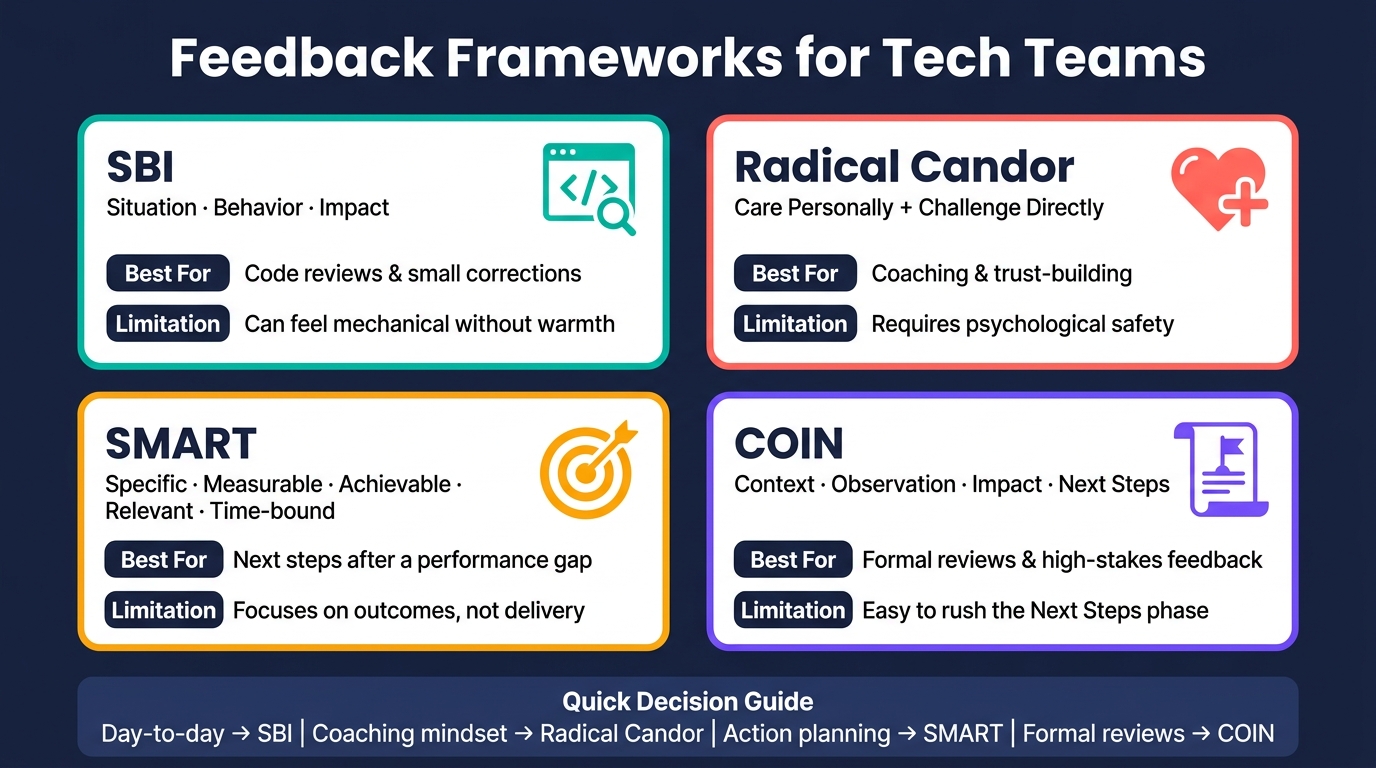
Feedback Frameworks for Tech Teams: SBI vs Radical Candor vs SMART vs COIN
Once your facts are straight and the timing makes sense, pick the lightest framework that fits the moment. The goal isn’t to sound polished. It’s to keep feedback specific and easy to act on.
How to Use SBI for Behavior-Based Feedback
SBI works well in engineering teams because it feels a lot like debugging: context, observed action, and impact.
For example: "During this morning’s incident postmortem (S), you rolled back the database without notifying the on-call lead (B), which led to 15 minutes of unnecessary troubleshooting by the SRE team (I)." That’s concrete, factual, and hard to argue with.
After you give the SBI statement, pause and ask: "How do you see it?" or "What was your intent?" That shifts the exchange from a one-way statement into an actual discussion. The same format also keeps technical feedback clear, whether you’re talking through code or a team interaction.
How to Apply Radical Candor and SMART Expectations Without Sounding Scripted
Radical Candor means caring personally and challenging directly. Miss one side of that, and feedback can slide into either avoidance or bluntness.
SMART helps turn the gap into a clear next step: Specific, Measurable, Achievable, Relevant, and Time-bound. So instead of ending with "improve your PR documentation," you close with "summarize the fix in the ticket." Now both sides know what done looks like. Use Radical Candor to shape the conversation, and use SMART to shape the action plan.
How to Pick the Right Framework for Each Situation
No single framework works for every case. Some are better for quick course corrections. Others fit formal reviews or tougher conversations. Here’s a practical side-by-side view for tech teams:
| Framework | Core Idea | Best Use Case in Tech Teams | Limitations |
|---|---|---|---|
| SBI | Situation, Behavior, Impact | Code reviews and small corrections | Can feel mechanical without genuine warmth |
| Radical Candor | Care Personally + Challenge Directly | Coaching and trust-building | Requires established psychological safety to land well |
| SMART | Specific, Measurable, Achievable, Relevant, Time-bound | Next steps after a performance gap | Focuses on outcomes, not on how the feedback is delivered |
| COIN | Context, Observation, Impact, Next steps | Formal reviews and high-stakes feedback | Easy to rush the "Next steps" phase, making it feel prescriptive |
A good default is simple:
- Start with SBI for most day-to-day situations
- Layer in Radical Candor as your mindset in coaching relationships
- Use SMART to close any conversation that needs a clear action plan
- Save COIN for formal reviews or high-stakes discussions where you need a built-in path forward
Next, use these same frameworks inside PRs, retrospectives, and 1:1s.
How to Build Feedback Into Everyday Tech Workflows
Use these frameworks inside the rituals your team already has. Feedback works best during the work itself, not months later in an annual review.
Giving Feedback in Code Reviews, Pull Requests, and Technical Discussions
Pull requests create a day-to-day feedback loop, so they’re a natural spot to build good habits. One of the biggest traps is sliding into style debates. Teams can burn time arguing about naming choices while missing bigger issues like correctness, design, security, or performance. A better move is to push style rules into an automated linter or pre-commit hook. That way, review comments can stay focused on what matters.
In reviews, talk about the code path or the tradeoff, not the developer. That small shift changes the tone fast. Instead of presenting an issue like a verdict, ask a question such as, "What was the reason for this pattern?" It opens the door to reasoning instead of defensiveness.
In live technical discussions, tie feedback to the tradeoff in front of the team: performance, maintainability, security, or user impact. Keep it grounded in the work. And when someone gets it right – a clean abstraction, a well-scoped function, or a careful tradeoff – call it out. Positive reinforcement helps just as much as correction.
The same idea carries into the next ritual: match the feedback to the purpose of the meeting.
Using Retrospectives, 1:1s, and Postmortems for Feedback
Each ritual has a different job. When teams blur those lines – say, by bringing up individual performance issues in a retrospective – trust can erode pretty fast.
| Ritual | Goal | Best Practice | Common Pitfall |
|---|---|---|---|
| Code Review | Technical quality & mentoring | Comment on approach; reinforce positives | Nitpicking style (use linters) |
| 1:1 Meeting | Coaching & sensitive topics | Include a feedback moment every time; use SBI | Saving feedback for annual reviews |
| Retrospective | Process & systemic issues | Use blameless language; focus on team-wide patterns | Gripe session without action items |
| Postmortem | Learning from incidents | Focus on how the system failed, not who failed | Blaming individuals for outages |
| Standup | Daily coordination | Surface blockers or dependency gaps | Deep technical feedback that stalls the meeting |
Use 1:1s for behavioral or sensitive feedback. They’re private, and they give the other person space to respond. Retrospectives are better for systemic issues the whole team owns. Postmortems should stay centered on how the system failed, not on finding a person to blame.
Giving Feedback in Remote and Hybrid Teams
Remote feedback is easy to misread. Tone gets fuzzy fast over chat, and short written comments can land harder than intended. For sensitive feedback, use live video first. Then send a short written recap with the next steps.
How to Follow Up and Build a Lasting Feedback Culture
Turn Feedback Into Clear Next Steps and Check-In Points
Once feedback shows up in PRs, retros, or 1:1s, the next step is what turns it into progress. Use the tracker you already have, your PR template, or your 1:1 agenda to write down one action, one owner, and one check-in date. That’s enough. You don’t need a big system to keep feedback from drifting.
When that check-in date comes around, make the outcome visible. If the change happened, call it out. If it didn’t, ask what got in the way. That small routine sends a clear message: feedback goes somewhere real. It doesn’t just disappear into a void.
How Founders and Team Leads Should Model Receiving Feedback
One of the fastest ways to wreck a feedback culture is for leaders to hand out feedback all day and then react badly when it’s aimed at them. Engineers notice. They pay close attention to how founders and team leads respond when feedback moves up the org chart.
A better way is simple: listen first, ask for one concrete example, and thank the person before you respond. Then take time to think it over. If you decide to act on it, make that link visible. For example, "You mentioned wanting more context, so I’ve added a ‘rationale’ section to this doc". That makes the change easy to see, and it shows the team that speaking up can lead to action.
When leaders handle feedback this way in public, the habit tends to spread.
Feedback also works better when it’s about behavior, not character.
Asking for feedback during retrospectives and 1:1s helps make this normal for everyone else. It shows that feedback is a two-way tool, not something used only by managers.
How to Support Psychological Safety and Avoid Feedback Burnout
Culture is shaped by what happens after the feedback talk, not just during it. Psychological safety is what makes feedback usable. Without it, people either tune out or shut down.
One practical way to protect that is to keep a rough 5:1 ratio of positive to constructive feedback. This isn’t about fake praise. It’s about saying the good stuff out loud too: a clean abstraction, a well-handled incident, a thoughtful PR description. If people only hear from you when something’s off, feedback starts to feel like a constant alarm.
It also helps to pause before turning every issue into a feedback moment. Ask yourself if the behavior is blocking, important, or simply a growth opportunity. Then match your response to the situation.
For founders dealing with stress and burnout, Work Smart, Not Hard covers habits that can help feedback cultures hold up over time.
FAQs
How do I give feedback without sounding personal?
Focus on the work, not the person. A simple way to do that is to use the SBI framework: situation, behavior, impact.
Stick to what you can observe. Name the situation, describe the behavior, and explain the impact. No guessing about intent. No labels. No “you always” or “you don’t care.” Think of it like this: if a camera had recorded the moment, could you point to the same facts on video?
You can also start by asking for the other person’s take first. That small shift often opens the door to curiosity instead of defensiveness.
When should feedback be public rather than private?
It depends on the message.
Public feedback works best when you’re giving praise, especially in team channels. It shows what good work looks like and gives everyone a clear example to follow.
Private feedback is better for critical or growth-focused conversations. A one-on-one or video call gives you space to stay respectful, read the other person’s reaction, show tone, and avoid mix-ups.
What if someone reacts defensively to feedback?
Defensiveness is often a natural response to feeling threatened, not a personal failing. So if someone gets guarded, try not to take it as proof that the talk is going off the rails.
Stay calm. Don’t match their tone or energy. Instead, acknowledge their point of view so they can see you’re listening.
Then bring the conversation back to observable facts with the Situation-Behavior-Impact model:
- Situation: Where and when it happened
- Behavior: What the person did or said
- Impact: What happened as a result
This helps keep the discussion centered on what happened, not on labels or character attacks. If emotions are still running hot, suggest taking a short pause and picking it up later.