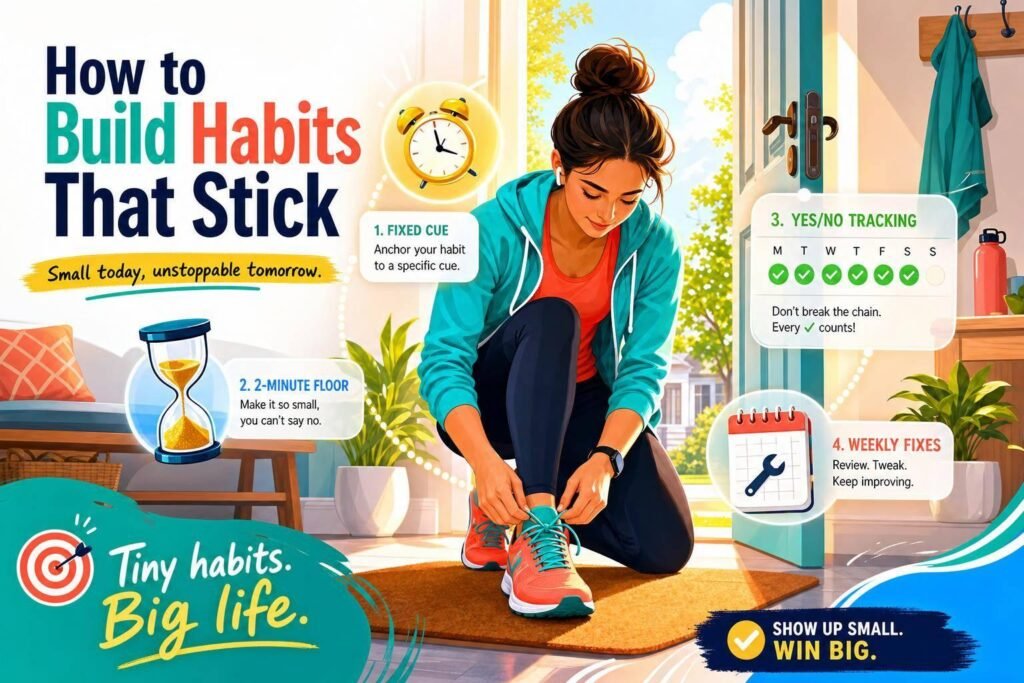
If I want a habit to last, I make it tiny, tie it to a fixed cue, track it with a simple yes/no check, and fix misses fast.
Motivation fades. Systems stay. This article boils habit-building down to a few moves that fit busy workdays, especially for founders and small teams dealing with context switching and too many decisions.
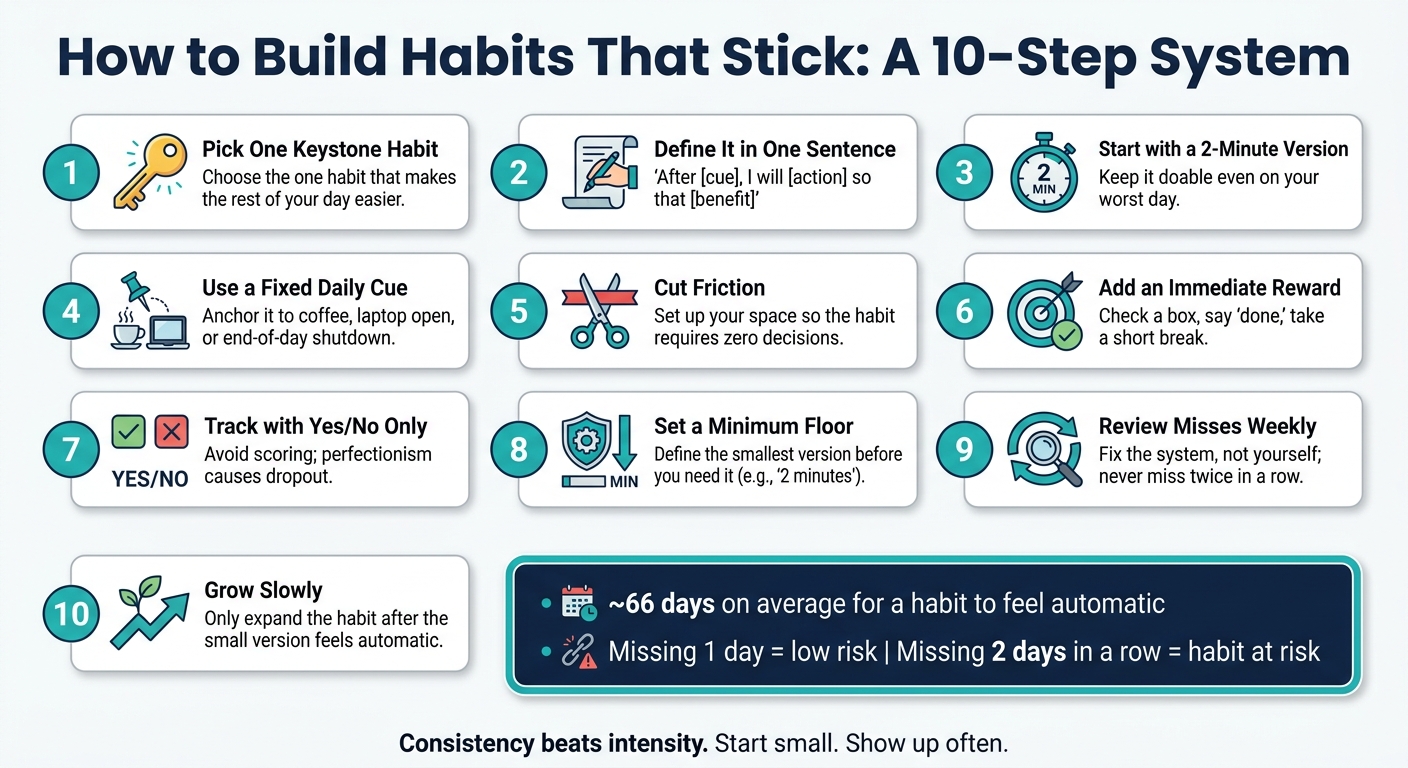
Here’s the whole playbook in plain English:
- Pick one keystone habit that makes the rest of the day easier
- Define the habit in one sentence: after X, I will do Y so that Z
- Start with a 2-minute version that still works on a rough day
- Use a fixed cue like coffee, opening your laptop, or shutting down work
- Cut friction by setting up your space ahead of time
- Add an immediate reward like checking a box or saying “done”
- Track with a simple yes/no method, not a score
- Set a minimum floor so you still do something when energy is low
- Review misses once a week and fix the system, not yourself
- Grow the habit slowly only after the small version feels automatic
A few numbers help explain why this works: research often shows it can take about 66 days on average for a behavior to feel automatic, and missing one day is far less harmful than missing two in a row. That’s why the article keeps pushing consistency over intensity.
The main point: I don’t need a big life overhaul. I need one small action, done often, with less thinking.
Read on if you want a simple way to build a habit that keeps going when your week gets messy.
How to Build Habits That Stick: A 10-Step System
The Science of Making & Breaking Habits: How to Change Your Life in 1 Month
sbb-itb-7c1dd7e
Choose One Keystone Habit and Define the Exact Behavior
Goals like "be more productive" or "improve focus" sound good. But they don’t tell you what to do. Pick one behavior with a clear result, then write down when you’ll do it and why.
Pick a Keystone Habit That Improves Multiple Areas at Once
A keystone habit is one action that sets off a chain reaction across focus, energy, and follow-through. For tech entrepreneurs, something like daily planning or an end-of-day shutdown routine can sharpen priorities, protect energy, and make it easier to recover after work.
A simple way to test it: ask yourself which one habit, if you did it every day, would make the rest of your day easier. If one habit stands out, that’s probably your keystone habit.
Write Your Habit as a Cue, Action, and Benefit Statement
After you choose the habit, turn it into a sentence you can actually use:
"After I [existing anchor], I will [new tiny action] so that [benefit]."
The cue should be fixed. Use something that happens every day, like finishing your first coffee, opening your laptop, or closing your last meeting. Skip cues that shift around, like lunch. If the trigger moves, the habit often slips with it.
Here’s how that looks in practice:
| Vague Goal | Specific Habit (Cue + Action) | Payoff |
|---|---|---|
| "Be more productive" | After I sit down at my desk, I will write my top 3 priorities. | Reduces decision fatigue and improves follow-through. |
| "Improve focus" | After I finish my first coffee, I will put my phone in a drawer for 60 minutes. | Creates uninterrupted work time for high-leverage tasks. |
| "Reduce stress" | After I close my laptop for the day, I will do 5 minutes of stretching. | Signals a clear boundary between work and home life. |
Keep the action small – under two minutes is a good place to start. Think of it this way: on a packed day, the habit should still feel doable. If it only works when your day is calm and perfectly planned, it’s too big.
Once the habit is clear, shrink it and tie it to a cue you can count on.
Build a Small Habit That Fits Into Your Day
Now make the habit easy to repeat, even on packed days. The next step is to cut the friction around that tiny version.
Use Habit Stacking and Workspace Setup to Reduce Friction
Habit stacking means linking the new behavior to something you already do each day: "After [Current Habit], I will [New Habit]." That works because the new behavior leans on an existing cue instead of sheer willpower.
Workspace setup backs that up. Put the tools for the habit where they’re easy to see and use without much thought – a notebook open on your desk or workout shoes by the door. Both moves lighten the decision load and help the behavior happen more automatically on busy founder days.
Once the habit has a steady cue, make it feel worth doing right away.
Make the Habit Feel Rewarding From Day One
Delayed rewards rarely build habits. Immediate rewards make the habit easier to repeat. And they don’t need to be fancy. Check off a tracker, take a two-minute break, or say "done" out loud.
For example, after closing your laptop, do 5 stretches and mark it in your habit log. That visible finish line helps completion feel satisfying.
On hard days, do the minimum version instead of skipping it. In the first month, focus on showing up, not performance.
Once the habit is easy and rewarding, track it so you can catch drift early.
Track Progress and Catch Problems Early
Once the habit is small and feels good to do, tracking helps keep it on course. It lets you spot drift early, before the habit fades out.
Pick a Tracking Method You Will Actually Use
Use the simplest tracking method you’ll open every day. Keep it to a yes/no check instead of scoring how well you did. Quality scores pull people toward perfectionism, and perfectionism often leads to dropout.
| Method | Ease of Setup | Level of Detail | Fit for Founders |
|---|---|---|---|
| Paper Calendar | High (Instant) | Low (Binary) | Best for single keystone habits |
| Simple Spreadsheet | Medium | High (Customizable) | Best for data-driven founders |
| Habit-Tracking App | Low (Initial setup) | Medium | Best for multiple habits or small teams |
A wall calendar can work well in a home office because the streak stays in sight all day. No app to open, no extra step. A spreadsheet fits founders who already think in numbers, but it can turn into busywork if you overbuild it. An app can help if you want reminders, though constant notifications and streak pressure can backfire if you miss a day.
Set a Minimum Success Rule and Do a Weekly Check-In
Define the smallest version of the habit before you need it. This is your floor on a rough day, like “2 minutes of focused work” or “one paragraph written.” It keeps the habit loop alive when time or energy drops.
Then add a weekly check-in. Look at the days you missed. Ask yourself if the cue showed up the way it should. If not, adjust it. And if you miss one day, use the “never miss twice” rule. The next day counts extra.
Fix Common Habit Failures Before They Break Your Streak
When a habit slips, fix the system first.
| Symptom | Likely Cause | Suggested Fix |
|---|---|---|
| Forgetting | Vague or missing cue | Use habit stacking to anchor it to a specific daily event. |
| Skipping when tired | Initial action is too big | Apply the minimum version. |
| Losing interest | Reward is too delayed | Add an immediate micro-reward like marking the tracker or checking a box. |
| Streak broken, feels like failure | All-or-nothing thinking | Track consistency over a rolling window instead of a binary streak. |
If you miss two days in a row, don’t treat it like a character flaw. Treat it like a signal. Shrink the habit, put the tools back where you can see them, and tie the action to a cue you can count on.
Once the habit keeps going even on bad days, you can start making it a little bigger.
Grow the Habit Into a Lasting Routine
Expand the Habit Gradually and Connect It to Existing Routines
Once the minimum version feels steady, the next move is to build on it without changing the cue. When a habit starts to feel automatic, you can make it a little bigger.
A simple way to do that is to link one habit to another. Instead of trying to start a completely new behavior from scratch, add the next step right after the first one. For example: after coffee, write 3 priorities; after writing priorities, open your daily planner. The anchor stays the same. The place stays the same. The timing stays the same. That matters more than most people think.
Keep the same place and time, because changing both at once makes the routine harder to keep going.
When the habit runs on autopilot, you can stop detailed tracking and put that energy into the next habit.
At that point, the main job is simple: be consistent.
Conclusion: Small Wins and Consistency Make Habits Last
The system in this guide is pretty simple: pick one keystone habit, cut it down to a 2-minute version, tie it to a cue you can count on, track it with the simplest method you’ll stick with, and fix the slips instead of giving up.
Motivation can get you started. Systems keep you going.
For tech entrepreneurs, a steady daily routine protects your attention, lowers decision fatigue, and reduces how many choices you need to make each day. When your most important behaviors happen with less effort, you have more focus for the work that needs your full attention. If you want more systems like this for your workday, Work Smart, Not Hard shares practical ways to handle time management, mental health, and productivity for founders.
Start with one habit. Keep it small. Show up often. The routine grows from there.
FAQs
What makes a habit a keystone habit?
The sources don’t give a clear technical definition of a keystone habit. Instead, they spend more time on the nuts and bolts of how habits work: cues, rewards, consistency, and habit stacking.
One source does mention keystone habits as an advanced strategy, but it stops short of defining the term. Based on the research available here, a habit is best understood as an automatic behavior triggered by a cue, reinforced by a reward, and strengthened through repetition.
What should I do if I keep missing my habit?
If you miss a day, don’t panic or quit. One missed day does almost nothing to your long-term progress.
The bigger problem is all-or-nothing thinking after a slip. That’s what turns one off day into a pattern.
Use the never-miss-twice rule: don’t skip two days in a row. Get back to it the next day with the smallest version of the habit. Then treat the miss as data. Look at what got in the way so you can spot your triggers.
When should I make the habit bigger?
Only make a habit bigger once it feels automatic and firmly in place. Early on, the goal is consistency, not output, so don’t scale it up too soon.
Once starting the habit no longer takes deliberate thought, you can extend it in a natural way.