

Startup founders often struggle to balance urgent tasks with long-term growth. Weekly goal planning helps shift focus from reactive work to proactive progress. By setting 2–3 measurable goals each week, you can align your efforts with key metrics, prioritize high-impact tasks, and keep your team on the same page.
Key takeaways:
- Focus on actions tied to metrics like revenue or user growth.
- Use tools like the RICE framework or an Effort-Impact Matrix to rank tasks.
- Limit weekly goals to 3–5 to avoid spreading yourself too thin.
- Align short-term goals with long-term objectives through OKRs and the BSQ method.
- Regularly review progress to adjust and stay on track.
Start small: Dedicate time each week to reflect, plan, and execute. Even small, focused changes can drive meaningful results for your startup.
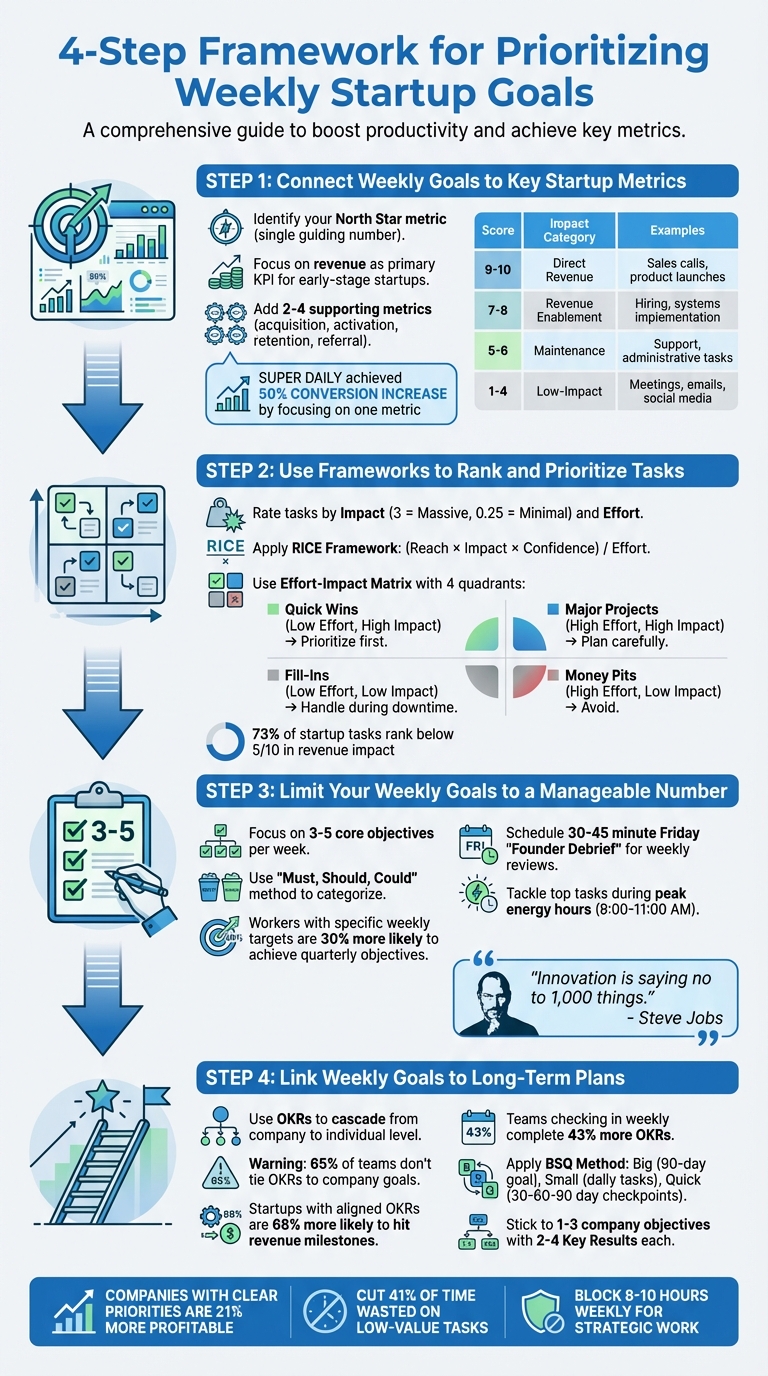
4-Step Framework for Prioritizing Weekly Startup Goals
Step 1: Connect Weekly Goals to Key Startup Metrics
Selecting Your Primary Metrics
Start by identifying a single North Star metric – a number that represents the core value your business delivers to customers. For example, a SaaS company might focus on weekly active teams, while a marketplace might track successful matches. This metric acts as your guiding light for decision-making.
For most early-stage startups, revenue should be the primary KPI. It’s a reliable indicator of product-market fit, unlike vanity metrics that may not reflect real progress. Alongside your North Star, pick 2–4 supporting metrics that align with your business funnel stages: acquisition, activation, retention, and referral. These should connect directly to the three strategic priorities you’ve set for a 90-day period to keep things manageable.
Take Super Daily, an Indian grocery subscription startup, as an example. They focused on improving conversion rates early on. By analyzing where signups dropped off, they discovered customers wanted a specific milk brand they didn’t carry. Adding that brand led to a 50% increase in conversion rates.
Once you’ve nailed down your metrics, the next step is turning those numbers into actionable weekly tasks.
Converting Metrics into Weekly Tasks
With your key metrics in place, the trick is to translate them into specific weekly actions that drive monthly results. Monthly revenue goals are lag indicators – outcomes you can’t directly control. Instead, focus on lead indicators: actionable, measurable steps that influence those outcomes. Align your monthly lag metrics with weekly lead indicators and daily actions to maintain momentum.
For instance, if your monthly revenue goal is $10,000, a weekly lead indicator might be scheduling five sales calls. To hit that, your daily action could be sending 100 outreach emails. Use revenue impact scoring to rank tasks based on their potential to drive revenue, scoring each on a scale of 1–10. Prioritize tasks scoring 9–10, like sales calls, product launches, and closing deals.
| Score | Category | Example Tasks |
|---|---|---|
| 9–10 | Direct Revenue Generation | Sales calls, product launches, closing deals |
| 7–8 | Revenue Enablement | Hiring key staff, building core systems |
| 5–6 | Maintenance | Customer support, basic administration |
| 1–4 | Low-Impact | Most internal meetings, non-strategic emails |
Removing Tasks That Don’t Add Value
To stay focused, align your tasks with your key metrics, ensuring every action contributes to moving your startup forward. For urgent tasks, apply the 10-10-10 Rule: ask if it will matter in 10 minutes, 10 months, or 10 years. Most urgent tasks only matter for 10 minutes and can be ignored in favor of actions with longer-term impact.
"People think focus means saying yes to the thing you’ve got to focus on. But that’s not what it means at all. It means saying no to the hundred other good ideas that there are. Innovation is saying ‘no’ to 1,000 things."
- Steve Jobs, Co-founder, Apple
Categorize tasks using the "Must, Should, Could" method:
- Must: Non-negotiable, critical to the business.
- Should: High-impact but flexible.
- Could: Nice-to-have but not essential.
Anything that doesn’t fit into the Must or Should categories should be deleted or delegated. Interruptions come with a steep recovery cost, so eliminating non-critical tasks isn’t just about productivity – it’s also a financial necessity. Staying laser-focused on high-value tasks is what drives real progress.
sbb-itb-7c1dd7e
Step 2: Use Frameworks to Rank and Prioritize Tasks
Rating Tasks by Impact and Effort
After listing your weekly tasks, the next step is to evaluate each one based on two key factors: impact and effort. Impact measures the value a task brings to your business, often tied to metrics like revenue, user growth, or retention. Effort, on the other hand, represents the resources needed – time, money, and manpower.
To keep things simple, rate impact on a scale of 3 (Massive), 2 (High), 1 (Medium), 0.5 (Low), and 0.25 (Minimal). This method helps you avoid wasting resources on tasks that deliver little value – commonly known as "Money Pits" – which drain resources without meaningful returns.
"Reach helps mitigate bias within the team. It ensures we don’t give preference to ideas that will only benefit a small, insignificant portion of our userbase."
- Leonie Lacey, Railsware
By using a structured rating system, you can avoid favoring ideas that sound exciting but fail to solve real customer problems. To keep the process efficient, limit discussions about each task’s rating to five minutes or less. This ensures you maintain momentum and avoid getting bogged down. For a more detailed approach, consider applying the RICE framework.
Using the RICE Framework
The RICE framework takes task evaluation a step further by adding more dimensions to the mix. RICE stands for Reach, Impact, Confidence, and Effort, and the formula is:
(Reach × Impact × Confidence) / Effort.
A higher RICE score means a task is more worthwhile.
- Reach: The number of users affected by the task.
- Impact: Measured on the same scale as before (3 for Massive, 0.25 for Minimal).
- Confidence: Your level of certainty about the estimates, rated as 100% (High), 80% (Medium), or 50% (Low). Anything below 50% suggests the data is speculative.
- Effort: The total work required, often calculated in person-days or person-months.
"RICE is a way to compare bets. Reach and Impact estimate the upside, Confidence discounts the upside when evidence is weak, and Effort is the cost of placing the bet."
- TheLinuxCode
When data is weak, lower the Confidence score for high-impact ideas. This naturally shifts focus to tasks backed by stronger evidence.
Creating an Effort-Impact Matrix
The Effort-Impact Matrix is a simple 2×2 grid that helps you visualize tasks based on their effort and impact. It’s a quick way to determine where to focus your energy. Here’s how tasks break down in the matrix:
| Quadrant | Effort | Impact | Strategy |
|---|---|---|---|
| Quick Wins | Low | High | Prioritize these first – they’re easy to complete and deliver big results. |
| Major Projects | High | High | Plan carefully and allocate resources strategically. |
| Fill-Ins | Low | Low | Handle during downtime; don’t let these take over more important tasks. |
| Money Pits | High | Low | Avoid these – they waste resources with little payoff. |
Focus on Quick Wins to build momentum and show progress. For Major Projects, schedule dedicated blocks of time for planning and execution. Use Fill-Ins to stay productive during slower periods. Lastly, eliminate Money Pits to free up resources for more impactful work.
Before diving into the matrix, align with your team on what qualifies as "High Impact" for your business. For example, does it mean a 5% boost in conversions? Clarity here minimizes unnecessary debates. Also, try scheduling your top three high-impact tasks during peak energy hours – typically between 9:00 AM and 11:00 AM.
Step 3: Limit Your Weekly Goals to a Manageable Number
Focusing on 2-5 Goals Per Week
Once you’ve tied your tasks to key metrics and established a framework, the next step is to narrow your focus. Trying to tackle everything at once is a common pitfall, especially for tech entrepreneurs. The ideal range for weekly goals is 3-5 core objectives. Anything beyond that tends to scatter your attention and reduce overall productivity.
Interestingly, about 73% of startup tasks rank below 5 out of 10 in terms of revenue impact. If you’re juggling ten priorities at once, chances are you’re spending a lot of energy on tasks that don’t make a big difference. Steve Jobs famously said, "Innovation is saying ‘no’ to 1,000 things". Your job is to pinpoint the 3–5 tasks that will truly drive progress.
A helpful tool for this is the "Must, Should, Could" method. It works by categorizing tasks into three levels of priority: "Must" for non-negotiable items, "Should" for high-impact but flexible tasks, and "Could" for optional, nice-to-have goals. Research shows that workers who set specific weekly targets are 30% more likely to achieve their quarterly objectives compared to those who stick to vague monthly goals. By focusing on fewer, high-impact goals, you ensure that every task is aligned with the metrics and frameworks that matter most.
Running Weekly Reviews
Once you’ve set your weekly goals, it’s essential to review and refine them regularly. Allocate 30–45 minutes every Friday for a "Founder Debrief." This session is your chance to reflect on wins, address challenges, and mentally reset for the week ahead. It’s not just about tidying up loose ends – it’s about staying intentional and proactive.
During your review, ask yourself questions like: What goals did I accomplish? What obstacles got in the way? What should I stop doing next week? Organizational psychologist Dr. Laura Chen emphasizes, "Short-term goals act as stepping stones that make big ambitions feel achievable". These reviews also create a feedback loop, allowing you to tweak your priorities and avoid distractions that don’t align with your larger objectives. By dedicating time to this process, your daily work becomes more about execution and less about figuring out what to do next.
Step 4: Link Weekly Goals to Long-Term Plans
Using OKRs for Goal Alignment
To keep your startup moving in the right direction, it’s critical to connect daily tasks to your bigger-picture goals. Many startups falter because their day-to-day work doesn’t align with their long-term objectives. This is where OKRs (Objectives and Key Results) come in. They create a clear path from your company’s overarching mission – your "North Star" – down to the specific tasks you tackle on a Monday morning. By cascading OKRs from the company level to departments and individuals, you can ensure that everyone stays focused on the same priorities.
But here’s a common issue: 65% of teams admit their OKRs aren’t actually tied to their company goals. To avoid this pitfall, break down quarterly OKRs into smaller, actionable milestones for each month and week. For instance, if your quarterly goal is to secure 100 G2 reviews, you might aim for 25 reviews in the first month, and in Week 1, focus on automating review requests. This approach transforms vague targets into clear, manageable steps.
The impact of well-defined OKRs is hard to ignore. Startups with aligned OKRs are 68% more likely to hit early revenue milestones, and teams that check in weekly complete 43% more OKRs than those who only review progress monthly. To keep things on track, assign a Directly Responsible Individual (DRI) to each Key Result. This person monitors progress and flags any roadblocks. As Steven Macdonald from OKRs Tool explains:
"OKRs work when they’re treated as a system, not a quarterly exercise".
To avoid overcomplicating things, stick to 1–3 company-level objectives with 2–4 Key Results for each objective. This approach keeps everyone focused and ensures that your weekly efforts are directly tied to your long-term vision.
Applying the BSQ Method
To complement OKRs, the BSQ (Big-Small-Quick) method provides an additional layer of structure that helps you turn plans into daily actions. The BSQ approach revolves around three components:
- Big: Define a major goal that spans 90 days to a year – this is your main direction.
- Small: Break that big goal into smaller, daily or weekly tasks that are manageable and build momentum.
- Quick: Establish short timeframes, such as 30, 60, or 90 days, to create urgency and checkpoints for progress.
The beauty of BSQ lies in its balance. By setting small, achievable tasks, you can maintain steady progress without feeling overwhelmed. For example, if your Big goal is to launch a new feature by Q3, your Small actions might include writing a single user story each day or conducting one customer interview per week. A Quick checkpoint at 30 days lets you evaluate whether you’re on track or need to adjust your approach.
This method is especially effective for startups that need to shift focus quarterly. For instance, Q1 might be all about growth, Q2 could center on improving product health, and Q3 might prioritize team culture. With BSQ, you can tackle each quarter with clarity and purpose, ensuring that your daily efforts consistently contribute to your broader objectives.
Conclusion
Key Takeaways for Startup Founders
Weekly goal prioritization boils down to focusing on what drives progress. These four steps can help your startup stay on track and keep moving forward. First, tie your weekly tasks to key metrics like revenue or active users, ensuring every action contributes to measurable growth. Next, use tools like the Eisenhower Matrix or Impact-Effort scoring to separate the important, strategic work from the distractions. Keep your goals limited to avoid losing focus. Finally, connect your weekly efforts to long-term objectives through OKRs, keeping your work aligned with your startup’s broader vision.
This structured approach makes a noticeable difference. Research shows that companies led by engaged leaders with clear priorities are 21% more profitable. Employees who set specific weekly goals are also 30% more likely to achieve quarterly milestones compared to those who rely on vague monthly goals. By cutting out the 41% of time that knowledge workers typically waste on low-value tasks, you can redirect that energy toward meaningful work that propels your business forward.
With these strategies in hand, you’re ready to turn your plans into actionable steps.
Getting Started with This Framework
You don’t need to overhaul your entire workflow overnight to see results. Start small. On Friday, take time to review your wins and challenges from the week. Then, on Monday, set one business-critical goal, one team-focused goal, and one personal goal. This ties back to aligning daily tasks with measurable outcomes. Use the 9–11 AM rule to tackle your most important tasks during your peak energy hours, and block off 8–10 hours each week specifically for strategic work. These hours are essential for moving the needle on your long-term goals. As Bill Rice, Founder of Bill Rice Strategy Group, aptly puts it:
"Your weekly plan is either fueling growth – or feeding chaos".
Check in on your progress every week and make adjustments as needed. The goal isn’t to achieve perfection – it’s to create a reliable system that makes planning second nature and builds the momentum your startup needs to thrive.
Adora Cheung – How to Set KPIs and Goals
FAQs
How do I pick my North Star metric?
Select one key metric that captures the essence of the value your startup delivers to customers and serves as a reliable indicator of long-term growth. This metric should do more than just look good on paper – it needs to align your team, inform strategic decisions, and remain relevant as your business evolves.
The goal is to focus on a measurement that directly ties to growth and customer value. Avoid getting distracted by vanity metrics – those numbers that might seem impressive but don’t reflect your product’s real impact. Instead, choose something that highlights how your product improves lives or solves problems. This way, your team can stay focused on what matters most as you scale.
What if I don’t have enough data for RICE scores?
If you don’t have enough data to calculate precise RICE scores, lean on your confidence and qualitative judgment. Use lower confidence scores or make estimates based on your experience. Evaluate Reach, Impact, and Effort qualitatively, and refine these assessments as more data comes in. This method allows you to stay adaptable without depending too heavily on incomplete information.
How do I handle urgent tasks without losing focus?
To handle urgent tasks while staying focused, consider using the Eisenhower Matrix. This tool helps you prioritize by sorting tasks into categories based on their urgency and importance. Another option is the Now/Next/Later method, which organizes tasks into what needs immediate action, what’s coming up soon, and what can wait for later. Adding a weekly reset routine can also help you clarify priorities and minimize decision fatigue. Lastly, set aside dedicated time for your most critical tasks, and delegate or automate less important ones to keep everything on track.