
Entrepreneurs often struggle to juggle business growth and personal well-being. A structured goal-setting system can help you stay focused, reduce overwhelm, and achieve measurable results. Research shows that writing down goals and sharing weekly updates boosts success rates by 76% compared to keeping goals private. Here are five proven systems to help you prioritize effectively:
- SMART Goals: Focus on clear, actionable targets that are Specific, Measurable, Achievable, Relevant, and Time-bound.
- OKRs (Objectives and Key Results): Align ambitious objectives with measurable outcomes to track progress.
- HARD Goals: Add emotional commitment to your goals using the Heartfelt, Animated, Required, and Difficult framework.
- Wheel of Life: Balance professional and personal priorities by assessing key areas of your life or business.
- 4DX (Four Disciplines of Execution): Execute critical goals by narrowing focus, tracking lead measures, and maintaining accountability.
Each system offers unique benefits, whether you’re aiming for short-term wins or long-term growth. Start with one that fits your current needs and build momentum by reviewing progress weekly.
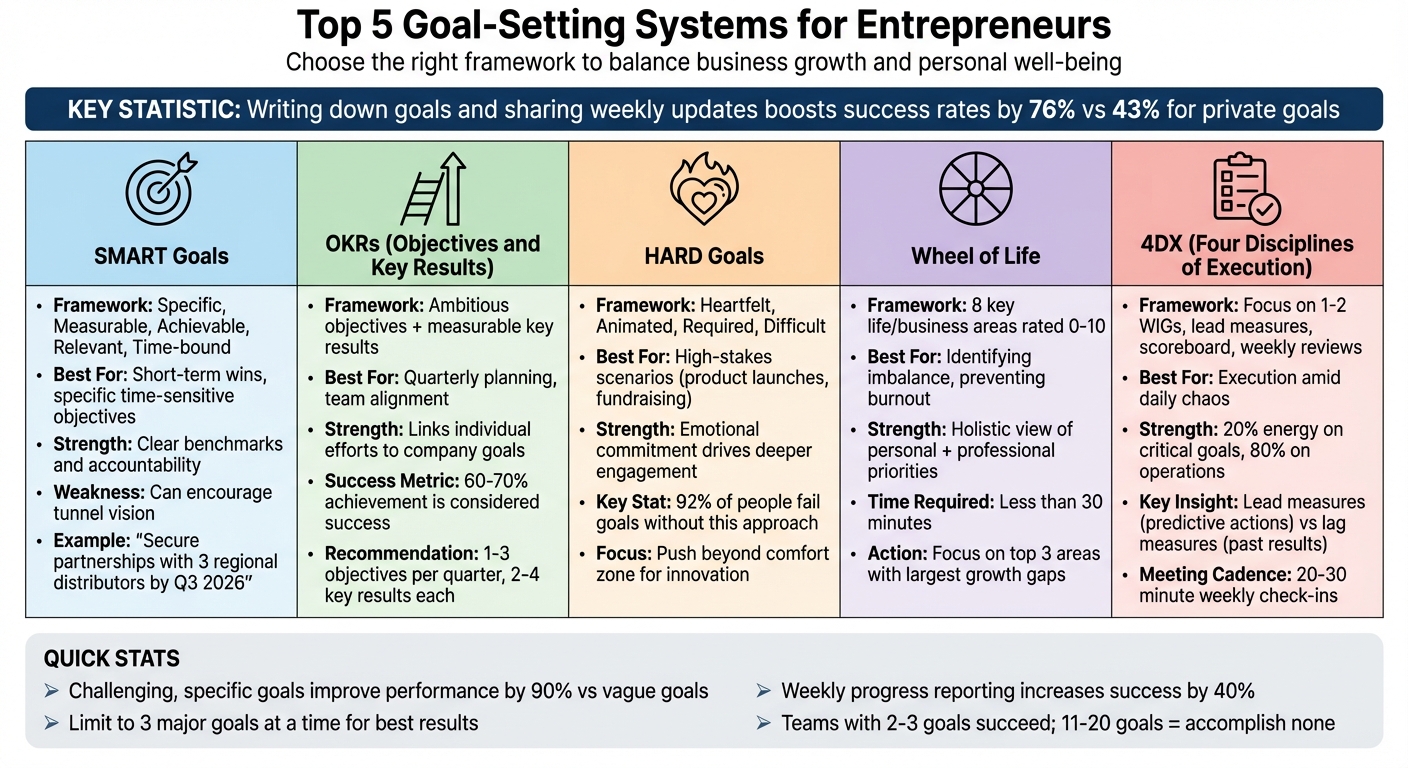
Comparison of 5 Goal-Setting Systems for Entrepreneurs
An Entrepreneur’s Guide to Goal Setting
sbb-itb-7c1dd7e
1. SMART Goals
SMART goals – Specific, Measurable, Achievable, Relevant, and Time-bound – offer entrepreneurs a structured way to turn vague aspirations into actionable plans. Instead of saying, "get better at marketing", a more defined goal would be: "secure partnerships with three regional distributors in Asia-Pacific by Q3 2026". Let’s dive into how measurable outcomes make these goals even sharper.
Focus on Measurable Outcomes
Clear, measurable targets help transform abstract ideas into tangible benchmarks. For instance, aiming to increase monthly users by 1,000 provides a straightforward measure of success. Similarly, setting a goal like achieving 98% uptime for core services gives a concrete performance metric. A great example comes from Q1 2022, when a product manager at Techfirm, Inc. boosted monthly mobile app users by 1,000. They achieved this by optimizing app-store listings and running targeted campaigns on platforms like Facebook, Twitter, and Instagram, aligning their efforts with profitability goals.
Practicality for Tech Entrepreneurs
For early-stage startups, SMART goals work exceptionally well for specific, time-sensitive objectives. Think of goals like launching a minimum viable product (MVP) within three months or completing Series A funding by a set quarter . The framework pushes entrepreneurs to aim high while staying realistic. By setting clear benchmarks for product milestones and performance metrics, founders can free up mental space to balance business growth with personal well-being by using essential strategies for tech entrepreneurs.
Balancing Personal and Professional Priorities
The relevant aspect of SMART goals encourages entrepreneurs to assess whether a goal benefits both their business and personal life. This ensures that goals don’t just tick all the SMART boxes but also drive meaningful progress. Tools like Strides and Todoist (around $5/month) help track both professional and personal goals in one place. Aligning business objectives with personal well-being is essential for maintaining sustainable growth.
"Wanting something is easy. Making it happen is hard. SMART goal setting helps you bridge that gap."
– Jesse Sumrak, Foundr
However, one potential downside of SMART goals is their tendency to encourage tunnel vision. While they’re excellent for accountability and operational focus, they can sometimes lead to an overemphasis on tactical wins at the expense of broader strategic thinking. To counter this, it’s important to complement SMART goals with systems that promote big-picture alignment and long-term organizational vision.
2. OKRs (Objectives and Key Results)
OKRs are a framework designed to connect ambitious goals with actionable steps. An Objective represents a broad, motivating aim, while Key Results are specific, measurable outcomes that track progress over a set timeframe. Originally developed at Intel, OKRs gained widespread popularity after Google adopted them early on.
Alignment with Entrepreneurial Goals
OKRs are particularly effective at linking individual efforts to the broader goals of a company. A great example comes from March 2025, when Vista, a Cimpress company, implemented OKRs using Oboard software under the leadership of Autumn Carulli, Director of Strategic Planning. This approach improved transparency across the organization, helping team members better allocate resources and understand how their tasks supported top-level objectives.
"OKRs help us communicate the top priorities and allow team members to allocate time and resources appropriately when faced with constraints."
– Autumn Carulli, Director of Strategic Planning, Vista
The framework encourages aiming for stretch goals, where achieving 60–70% is considered a success. This mindset, famously described by John Doerr as "70 percent is the new 100 percent", allows startups to push boundaries without fearing failure. For entrepreneurs, it’s about striving for groundbreaking results instead of settling for easily attainable ones.
This alignment doesn’t just stay at the strategic level – it naturally integrates into daily operations, as shown below.
Practicality for Tech Entrepreneurs
OKRs help break down a startup’s vision into manageable, measurable steps. Their quarterly structure creates natural checkpoints, allowing teams to adjust priorities as market conditions evolve. Tu Le, CEO of MyStudio, highlights the benefits of this clarity:
"OKRs provide clarity, alignment, and momentum. In a rapidly scaling SaaS company, distractions like feature requests and shifting market trends are common."
– Tu Le, CEO, MyStudio
To stay focused, aim for 1–3 objectives per quarter, each with 2–4 key results. Assign ownership of each Key Result to ensure accountability without micromanaging. Weekly check-ins – preferably asynchronous – can help track progress and tackle obstacles. Interestingly, a study of over 7,800 Key Results in startups revealed that 52% were merely "KPIs in disguise", focusing on maintaining the status quo rather than driving meaningful change. To avoid this, make sure your Key Results measure progress (e.g., "Increase activation rate from 30% to 45%") instead of static metrics (e.g., "Maintain 99% uptime").
Balancing Personal and Professional Priorities
OKRs aren’t just for business – they can also help structure personal goals. Take James McAulay, CEO of Encore, who completed the Ironman Wales triathlon in September 2022 by using a personal OKR system he created in 2018. He broke his "Fitness" objective into measurable Key Results, like running 100k and cycling 500k per quarter, and enlisted an accountability partner to check in every four weeks.
"The beauty of this system is that it turns fuzzy and ambiguous goals… into quantifiable and measurable metrics."
– James McAulay, CEO, Encore
For entrepreneurs balancing intense work demands, setting one personal objective per quarter can help maintain focus. Start by defining a high-level mission statement (e.g., "Finish the year as the best version of myself"). Tools like the Wheel of Life can help identify areas needing attention, such as health, relationships, or career . By applying OKRs to personal ambitions, you can bring the same level of structure and clarity to your life outside of work.
3. HARD Goals
HARD goals take traditional goal-setting frameworks to the next level by adding an emotional layer that drives deeper commitment. Designed by Mark Murphy, this method uses four key elements – Heartfelt, Animated, Required, and Difficult – to make goals more engaging and harder to abandon.
Alignment with Entrepreneurial Goals
Here’s a staggering statistic: 92% of people fail to achieve their goals, according to research from the University of Scranton. For entrepreneurs, this often happens because goals feel disconnected from personal values or lack the urgency needed to spark action. That’s where the Heartfelt element comes in – it ties your business goals to what truly matters to you on an emotional level, ensuring you’re not just chasing numbers but pursuing something meaningful.
The Animated aspect focuses on vividly imagining your success and communicating your vision in a way that inspires both you and your team. Meanwhile, the Required component builds urgency by setting strict deadlines and removing safety nets, forcing you to treat the goal as non-negotiable. Finally, the Difficult element challenges you to aim higher, pushing boundaries and fostering innovation.
Focus on Measurable Outcomes
Emotional alignment is powerful, but measurable actions are what bring HARD goals to life. Research shows that writing down goals and sharing weekly progress with an accountability partner can significantly boost success rates – 76% of people who do this achieve their goals, compared to just 43% who keep their goals private. That’s a nearly 40% improvement!
To make HARD goals work, start by creating a personal mission statement for each major project to ensure it feels Heartfelt. Use visualization techniques to paint a clear mental picture of success, aligning with the Animated element. For the Required component, set firm deadlines and eliminate fallback options to emphasize the goal’s importance. Lastly, aim for Difficult targets that push you into what researchers Locke and Latham describe as the "optimal difficulty zone", where growth and achievement intersect.
Practicality for Tech Entrepreneurs
HARD goals are especially effective for short-term, high-stakes scenarios like product launches, fundraising campaigns, or sprint cycles. Unlike SMART goals – which often focus on "Achievable" targets that can result in overly cautious planning – HARD goals encourage ambitious objectives that spark innovation .
For tech entrepreneurs navigating fast-paced, competitive markets, this approach is invaluable. Incremental changes rarely lead to game-changing results, but HARD goals can push you toward breakthroughs. To stay on track while juggling multiple priorities, consider using a momentum-based system to monitor daily progress in key areas like career, learning, and relationships. As automation takes over routine tasks, HARD goals help you focus on the creative and strategic work that only humans can do effectively.
4. The Wheel of Life
The Wheel of Life is a simple yet powerful tool that breaks your life – or business – into eight key areas, helping you see where you’re thriving and where you might be falling behind. Executive coach Ravi Raman explains it well:
"You can only run your life headstrong in a single direction for a limited amount of time before the proverbial ‘wheels’ fall off the car of life".
For tech entrepreneurs, who often get laser-focused on things like product launches or raising capital, this framework can help prevent burnout and imbalance. Just as SMART goals and OKRs bring structure to achieving objectives, the Wheel of Life ensures you’re balancing your professional ambitions with your personal well-being.
Balancing Personal and Professional Priorities
The traditional Wheel of Life includes areas like Health, Relationships, Finances, and Personal Growth. But for tech entrepreneurs, it can be adapted into a "Wheel of Business" with categories like Product Innovation, Customer Retention, Financial Health, Team Growth, Marketing & Sales, Operations, Strategic Planning, and Competitive Analysis. This customized version helps you track not only personal satisfaction but also the efficiency and health of your startup. It’s a way to avoid the common pitfall of overinvesting in one area while neglecting others.
The process is quick – taking less than 30 minutes – and offers immediate insights. You rate each slice on a scale from 0 to 10 based on your current satisfaction, then mark where you’d like to be in a year. This reveals your "growth gap", or the areas that need the most attention. Think of Mike Tyson, who earned an estimated $300 million but ended up in financial ruin because he neglected key aspects of his life like education, relationships, and long-term planning. His story is a stark reminder of what can happen when critical areas are overlooked.
Practicality for Tech Entrepreneurs
Instead of trying to tackle every slice at once, focus on the top three areas with the largest growth gaps. For each, ask yourself: What small action can I take today? What would a perfect 10 look like? What challenge am I avoiding? Then, take one immediate step – no matter how small – before closing your laptop. This approach helps you beat procrastination and start building momentum.
Addressing even one area, like setting boundaries or prioritizing your health, can have a ripple effect, improving your leadership and decision-making skills. As Tony Robbins famously said:
"Without a vision, people perish".
In just half an hour, the Wheel of Life gives you a clear vision of where to focus your energy, making it an incredibly effective exercise for busy entrepreneurs. It’s a starting point for creating systems that lead to better execution and sustainable growth. Up next, we’ll dive into a framework designed to turn that vision into disciplined action.
5. Four Disciplines of Execution (4DX)
The Four Disciplines of Execution (4DX) takes goal-setting a step further by focusing on how to execute priorities effectively. While frameworks like the Wheel of Life help pinpoint areas to prioritize, 4DX provides a clear path to achieve those priorities, even when daily demands – like endless emails, client emergencies, or unexpected tasks – threaten to derail progress. For tech entrepreneurs, this system can be a game-changer when it feels like there’s never enough time to focus on what truly matters, even with the best productivity websites at your disposal.
Alignment with Entrepreneurial Goals
The central idea of 4DX is straightforward: most goals fail not because of a lack of effort, but because day-to-day responsibilities consume all your time and energy. Research highlights that only 15% of employees can name even one of their organization’s key goals, which underscores the need for focus. 4DX helps by reserving 20% of your energy for your most critical objectives – called Wildly Important Goals (WIGs) – while accepting that the other 80% will go toward maintaining daily operations. Like other frameworks, it emphasizes zeroing in on the efforts that create the most impact.
The first discipline of 4DX is all about narrowing your focus to just 1–2 critical goals. These goals must follow a precise format: "From X to Y by when". For instance, "From $50,000 to $100,000 in monthly recurring revenue by December 31, 2026." The idea isn’t to limit ambition but to acknowledge that teams with too many goals – say, 11–20 – often accomplish none, while those with just 2–3 goals are much more likely to succeed.
Focus on Measurable Outcomes
What sets 4DX apart is its emphasis on lead measures rather than lag measures. Lag measures, like revenue or churn rates, only tell you what has already happened. Lead measures, on the other hand, focus on predictive actions – like the number of product demos or code updates – that directly influence outcomes.
"You can lead LEAD MEASURES but LAG MEASURES could leave you lagging behind because you can’t control them directly".
This shift in focus has delivered impressive results. For example, tracking lead measures helped generate an additional $5.7 million in revenue in the early 2010s. Similarly, DeKalb Medical Center saw patient satisfaction skyrocket from the 3rd percentile to the 99th percentile nationally by concentrating on lead measures.
Practicality for Tech Entrepreneurs
The third and fourth disciplines are about creating actionable systems: a visible scoreboard and a short weekly review session. The scoreboard tracks progress in real time, while the 20–30 minute weekly check-ins allow teams to evaluate results, refine lead measures, and keep momentum going. Aric Burke, Founder and CEO of Atlas Healthcare Partners, highlighted the value of this structure:
"It created the system, the structure that we needed desperately… and it lead to great results ultimately, I don’t think we would be where we are right now without that structure".
For tech entrepreneurs, one of 4DX’s strengths is how seamlessly it integrates with other tools. You can pair it with OKRs for quarterly planning or combine it with the Wheel of Life to balance professional and personal goals. To get started, identify your top 1–2 WIGs, define 2–3 lead measures for each, set up a scoreboard, and commit to weekly accountability sessions. Within weeks, you’ll know if your lead measures are driving progress – and if they’re not, you can pivot before wasting months of effort. By blending 4DX with your existing systems, you can turbocharge business growth while maintaining a sense of balance in your life.
Conclusion
Looking back at the systems discussed earlier, one thing is crystal clear: setting focused goals is a key ingredient for both business achievements and personal balance.
Entrepreneurs thrive – and avoid burnout – by using structured methods to set and track their goals. Research shows that having challenging, specific goals can improve performance by 90% compared to vague ones. Plus, people who write down their goals and share weekly progress reports achieve 76% of them, while those who keep goals private only reach 43%. Without a clear framework, 92% of goals remain unmet. That’s the difference a good system can make.
Each framework we covered tackles unique challenges. SMART goals help nail down precise, actionable steps. OKRs push teams toward bold, ambitious outcomes. HARD goals tap into emotional drive when motivation wanes. The Wheel of Life ensures personal well-being isn’t sidelined for professional wins. And 4DX builds the discipline needed to stay on track, even when life gets hectic. Together, these tools not only propel business growth but also help maintain a healthy work-life balance.
It’s wise to limit your focus to just three major goals at a time. Taking on more often spreads your energy too thin and leads to average results. As Steve Jobs famously said:
"People think focus means saying yes to the thing you’ve got to focus on. But that’s not what it means at all. It means saying no to the hundred other good ideas that there are".
This level of prioritization can be the deciding factor between steady progress and burnout.
To sum it up, a disciplined, well-thought-out approach to goal-setting can completely reshape your entrepreneurial path. Start with one framework that fits your current needs – whether it’s alignment, execution, or maintaining balance – and commit to reviewing your progress weekly. Reporting your progress weekly can increase your success rate by 40%. Once you’ve built momentum, you can layer in other systems. The goal isn’t to achieve perfection but to create a sustainable rhythm that keeps you moving forward without compromising your health or relationships.
For more tips on staying productive without burning out, check out Work Smart, Not Hard. The tools are there, the research backs them up, and now it’s up to you to pick a system and get started.
FAQs
Which goal-setting system should I start with?
Starting with SMART goals is a solid approach. This tried-and-true framework ensures that your objectives are Specific, Measurable, Achievable, Relevant, and Time-bound. By setting goals this way, entrepreneurs can track progress more easily and stay laser-focused on what matters most. It’s a practical method for aligning personal ambitions with professional priorities, helping you stay on course without feeling overwhelmed.
Can I combine SMART goals, OKRs, and 4DX?
Yes, you can use SMART goals, OKRs, and 4DX together because they work well as a team. OKRs provide broad objectives paired with measurable results, SMART goals bring clarity and ensure targets are realistic, and 4DX emphasizes execution and accountability. When combined, these methods align strategies, outline clear action steps, and keep attention on the most critical priorities, offering a well-rounded approach to achieving goals.
How do I track goals weekly without burning out?
To stay on top of your goals every week without feeling overwhelmed, stick to a straightforward and manageable plan. Start by breaking your goals into smaller, achievable tasks. Then, set aside a short time each week to review your progress and map out the next steps. A simple tool like a calendar can help you stay organized and focused on just a few key actions at a time. If things don’t go as planned, don’t sweat it – adjust your strategy with kindness toward yourself, rather than striving for perfection.