
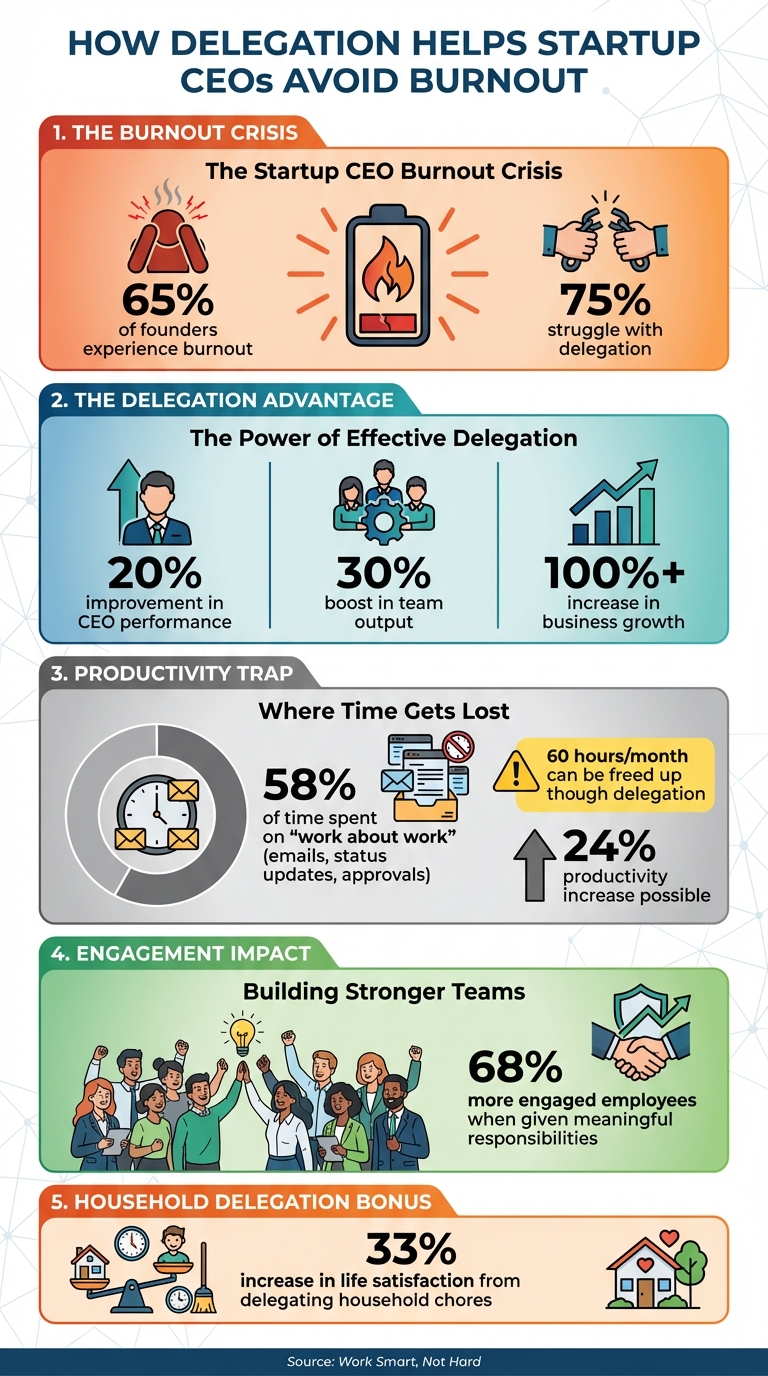
Startup CEOs often face burnout due to excessive workloads, financial pressures, and the inability to delegate effectively. Studies show 65% of founders experience burnout, and 75% struggle with delegation, which can lead to overwork and hinder growth. Delegation, when done right, allows CEOs to focus on high-priority tasks and improves both personal well-being and team performance.
Key takeaways:
- Delegating improves CEO performance by 20% and boosts team output by 30%.
- Effective delegation can increase business growth by over 100%.
- Tools like SOPs, time audits, and frameworks (e.g., the 10/80/10 Rule) simplify delegation.
Start small: Identify low-value, energy-draining tasks to delegate first. Use clear processes, set expectations, and avoid micromanaging. By building trust and systematizing workflows, CEOs can reduce burnout, improve decision-making, and focus on scaling their business.
Startup CEO Delegation Statistics and Benefits
Delegation Principles and Benefits
What Delegation Means
Delegation isn’t just about handing off tasks – it’s about transferring both responsibility and authority. In other words, you’re giving someone full ownership of the outcome, not just a to-do list. To make this work, it’s critical to set clear expectations so your team knows exactly what success looks like.
The backbone of effective delegation lies in Standard Operating Procedures (SOPs). These documented processes allow your team to operate consistently without needing constant input from you. One AE&Co client shared their experience:
"AE&Co’s Process Database Program gave my team everything they needed to deliver at a high level – without me having to answer every question".
If writing detailed manuals feels overwhelming, try recording short instructional videos instead. This approach lets you build a library of resources quickly and effectively [8, 11].
By mastering these basics, startup CEOs can unlock a range of powerful benefits.
Main Benefits of Delegation for Startup CEOs
Structured delegation isn’t just about reducing your workload – it can also elevate your team’s performance and resilience. Research shows that CEOs who delegate effectively can boost their own performance by 20% and their team’s performance by 30%. Delegation also eliminates routine decision fatigue, freeing up mental energy for high-impact strategic decisions.
Take this example: A fintech founder delegated tasks like calendar management, investor updates, and travel planning to an Executive Assistant. This saved them 10 hours per week, which they reinvested in refining their product strategy. The result? A 40% increase in revenue within a year.
Delegation also strengthens your organization in the long run. When responsibility is shared across the team, the company becomes less dependent on the CEO. Plus, employees who are trusted with meaningful responsibilities are 68% more engaged. This not only improves retention but also fosters a more empowered and capable workforce. As executive coach Simona Spilak puts it:
"Delegation isn’t a sign of weakness – it’s the only way to build a stronger, more capable team while leading sustainably for you and the organization".
sbb-itb-7c1dd7e
How to Identify Tasks to Delegate
Task Prioritization Methods
Deciding which tasks to delegate can feel overwhelming, but using structured methods like the E-Value Matrix can make the process easier. This tool helps categorize tasks based on the energy they require and the value they bring to your business.
- Focus Zone: These are high-energy, high-value tasks, such as setting the company’s vision, forming major partnerships, or shaping workplace culture. These responsibilities are central to your role and should stay on your plate.
- Danger Zone: Tasks in this category demand a lot of energy but deliver little value. Think of activities like chasing down signatures, coordinating travel, or handling intricate administrative details. These are prime candidates for delegation.
Another strategy is to delegate tasks your team can handle at about 70% of your efficiency. The 10/80/10 Rule is a great framework for this: you define the vision (10%), your team executes most of the work (80%), and you step in to finalize or refine it (10%).
For a more numbers-driven approach, calculate your "buyback rate." Divide your annual income by 2,000 hours to find your effective hourly rate, then divide that by four. Any task that costs less than this rate is worth delegating. For example, tasks like scheduling (which might cost $10–$100/hour to outsource) can be offloaded, allowing you to focus on high-value activities like fundraising or strategic planning, which could yield $1,000+/hour returns.
By applying these methods, you can quickly pinpoint tasks that drain your energy without delivering meaningful results.
Identifying Energy-Draining vs. High-Impact Tasks
Once you’ve categorized your tasks, the next step is identifying which ones sap your energy versus those that create real impact. Energy-draining tasks are often the ones you procrastinate on, take twice as long to complete, and leave you mentally drained without producing significant results. Common culprits include managing your inbox, troubleshooting tech issues, handling routine team communications, and processing expense reports.
Research highlights a major productivity trap: workers spend 58% of their time on "work about work", like emails, status updates, and chasing approvals, instead of focusing on strategic tasks. These communication-heavy activities can eat up hours of your week, leading to a noticeable drop in productivity.
To get a clear picture of where your time and energy are going, try a 7-day time audit. Track every activity, note how long it takes, and rate your energy level afterward on a scale of 1 to 5. This exercise will reveal patterns, showing which repetitive, low-value tasks you should delegate.
Start by tackling the task that frustrates you the most, even if it’s not the biggest time drain. This "annoyance-first" approach provides quick relief and builds momentum for delegating more tasks. Entrepreneur Tim Ferriss offers a helpful reminder:
"Never automate something that can be eliminated, and never delegate something that can be automated or streamlined. Otherwise, you waste someone else’s time instead of your own".
Delegating energy-draining tasks can free up as much as 60 hours per month and boost productivity by 24%. By offloading these responsibilities, startup CEOs can focus their energy on strategic initiatives that drive growth and enhance overall well-being.
How to Delegate Effectively
Creating a Delegation Framework
Start by recording yourself performing tasks using screen capture tools. This simple step helps document the process and reasoning behind each task, making it easier to shift your focus from daily operations to bigger-picture planning. A well-structured framework allows CEOs to prioritize strategic goals over routine responsibilities.
The Designer OS Framework provides four key pillars for effective delegation: Outcomes, Owners, SOPs, and Metrics. First, define Outcomes – clearly outline what success looks like. Then, assign Owners – identify who will be accountable. Develop Standard Operating Procedures (SOPs) to detail how tasks should be completed. Lastly, track Metrics to measure progress and results. A RACI Matrix can also help clarify roles by specifying who is Responsible, Accountable, Consulted, and Informed.
When handing off tasks, use a 3-Part Delegation Brief to minimize confusion. This brief should include:
- Outcome: What "done" looks like.
- Context: Why the task matters and how it fits into broader goals.
- Resources: Tools, templates, or access needed to complete the task.
To prioritize what to delegate, try a Delegation Rubric. For instance, score tasks based on repeatability (+1 point), impact (+2 points), and low difficulty (+1 point). Setting clear "delegation budgets" can further empower your team. For example, define limits like "spend up to $500 to solve this" or "allocate 10 hours to research options."
Once you’ve established a framework, focus on building trust and setting clear expectations.
Building Trust and Setting Clear Expectations
Delegation works best when supported by both People Trust (confidence in an individual’s abilities) and Process Trust (confidence in your organizational systems). Tailor the level of autonomy you give based on the team member’s competence and experience.
The 5-Level Delegation Ladder is a helpful tool for determining how much authority to delegate:
- Do exactly as I say: Ideal for routine or straightforward tasks.
- Research and report back: Gather information but hold off on decisions.
- Provide recommendations: Suggest solutions for approval.
- Make the call, but keep me informed: Decide independently while updating the leader.
- Act independently with full ownership: Reserved for experienced team members.
Focus on delegating reversible, low-consequence decisions first to build confidence and speed. Encourage team members to ask "yes-able questions" by presenting recommendations for approval, such as, "I recommend X because of Y; does this work for you?"
"Delegation is a leadership habit that develops people and builds a resilient operating system, not a last-resort time saver."
– Kamyar Shah, Fractional COO and Executive Coach
Set clear checkpoints for delegated tasks. For example, establish a kickoff meeting, an optional mid-point review, and a final delivery review. This approach ensures quality without micromanaging. When providing feedback, follow a four-step process: start with praise, point out mistakes and their impacts, ask the team member to restate the feedback, and have them outline their plan to prevent future errors.
Once trust and expectations are in place, the next step is avoiding micromanagement.
Avoiding Micromanagement
Micromanagement often stems from focusing on individual tasks instead of the desired outcome. Clearly communicate the "why" and the goal, then allow your team the freedom to execute. This approach encourages independence and frees up your mental energy for higher-level priorities.
Adopt a Progressive Delegation Model, starting with simpler tasks like scheduling or data entry. Over time, move on to more complex, high-impact projects as your team gains confidence and competence.
Instead of constant check-ins, create a searchable database of SOPs and video walkthroughs. This resource allows your team to troubleshoot issues on their own while maintaining consistency. It’s a strategy of "codified quality" that balances autonomy with reliability.
When mistakes happen, resist the urge to take tasks back. Instead, coach the team member by discussing the alternative solutions they considered and their thought process. As Yuval Karmi, Founder and CEO of Glitter AI, explains:
"Delegation isn’t about letting go. It’s about documentation."
Take inspiration from Ritz-Carlton, which empowers employees with a $2,000 discretionary budget to resolve customer issues immediately, without needing approval. This approach sets clear boundaries while enabling quick, independent decisions. It’s a model startup leaders can adapt to their own delegation strategies, ensuring quality and preserving leadership focus.
Maintaining Work-Life Balance and Recovery
Setting Work-Life Boundaries
Establishing clear boundaries between work and personal life is essential for maintaining long-term effectiveness as a leader. One way to do this is through context blocking, where you group similar tasks together on your calendar. For instance, you could schedule all vendor meetings on Tuesdays and reserve Thursdays for internal discussions. This reduces the mental strain of constantly switching between unrelated tasks, helping you stay focused and efficient.
Another tool is creating an Executive Access Guide. This document outlines your availability, preferred communication channels (e.g., email for non-urgent matters, Slack for urgent ones), and expected response times. It sets clear expectations and minimizes interruptions. You might also designate "No-Call" days – such as Mondays or Fridays – dedicated to deep work and strategic planning, free from external meetings.
"Boundaries aren’t walls; they’re clarity. And that clarity protects not just my time, but my creativity, relationships, and ability to lead effectively." – Stephanie High, Founder/CEO, Kaizen Catalyst
Setting a "Hard Stop Hour" at the end of each workday can prevent your job from spilling into personal time. Similarly, starting your mornings with a quiet hour for activities like meditation, journaling, or exercise can help you set the tone for the day. Nickquolette Barrett, Executive Career Coach at iRock Résumés, emphasizes the importance of sticking to these boundaries:
"Stick to the office hours you set as if your peace depends on it – because, spoiler alert, it does"
Even small adjustments, like avoiding caffeine and sugar after 2:00 PM, can improve your sleep and focus, ensuring you’re at your best.
Once these boundaries are in place, scheduling intentional periods of rest and recovery becomes the next step in maintaining balance.
Scheduling Rest and Recovery Time
Rest isn’t a luxury – it’s a necessity. Block out one full day each week where you completely unplug from work. Plan for quarterly three-day weekends and take at least one extended vacation (1–2 weeks) annually, fully disconnected from work. These breaks help recharge your energy, which directly impacts your ability to lead effectively.
| Recovery Type | Frequency | Duration | Key Benefit |
|---|---|---|---|
| Morning Routine | Daily | 30–90 Minutes | Mental clarity and readiness |
| No-Work Day | Weekly | 24 Hours | Prevents burnout and resets focus |
| Date Night | Weekly | 3–4 Hours | Strengthens personal relationships |
| Mini-Retreat | Quarterly | 3 Days | Reduces stress and offers perspective |
| Full Vacation | Annually | 1–2 Weeks | Enables deep recovery |
Start your day with a 30–90 minute routine focused on grounding and mental clarity – whether through exercise, meditation, or reading. Prioritize physical activity at least three times a week, ideally with a workout partner or trainer for accountability. Treat personal commitments, like date nights with your partner or family, with the same importance as business meetings.
To free up time, consider outsourcing personal tasks like bill payments, online shopping, or scheduling family activities to an executive assistant. Studies show that delegating household chores can increase life satisfaction by 33%. If you find yourself in a “red zone” of burnout, take a 24 to 48-hour break from all notifications to reset.
Using Peer and Professional Support
Leadership can feel isolating, and that loneliness often leads to stress. In fact, 50% of CEOs report feeling lonely, with 61% saying it negatively affects their performance. Joining peer networks or mastermind groups can provide a safe space to share challenges and receive advice without risking your authority with your team.
A great example of this is Matt Munson, former CEO of Twenty20. At a CEO bootcamp in 2016, Munson participated in a "Clearness Committee" exercise where peer CEOs helped him recognize his burnout. This clarity allowed him to create a 30-month plan that ultimately led to the successful sale of his company in 2019.
Statistics back up the value of these networks – CEOs in peer groups experience over 200% faster revenue growth compared to their peers. To get the most out of these groups, join ones that match your company’s size and stage (e.g., $5 million to $50 million in revenue) and ensure there’s a non-competition agreement so you can discuss sensitive issues freely.
Professional support is just as important. Build relationships with therapists or executive coaches before a crisis hits. Joel Gascoigne, Founder and CEO of Buffer, hired a second Executive Assistant in 2018 to help him establish a professional support network, which included a therapist, a coach, and a peer founder group. Reflecting on his experience, Gascoigne noted that having a coach earlier could have eased the challenges of working with his co-founder during a period of burnout.
"Rest alone rarely fixes founder burnout… Rest isn’t the solution. Alignment is the solution." – Matt Munson, Former CEO, Twenty20
For more tools and strategies to manage mental health, improve time management, and avoid burnout, visit Work Smart, Not Hard. Their resources are tailored specifically for tech entrepreneurs navigating these challenges.
Conclusion
Key Takeaways for Startup CEOs
Delegation isn’t just about lightening your workload – it’s about building a strong team and protecting your mental well-being. Here’s why it matters: 65% of startup founders experience burnout, but those who delegate effectively can see growth rates soar past 100%. Plus, leaders who delegate improve their performance by 20% and boost their team’s output by 30%.
Making the leap from doing everything yourself to creating systems requires three major shifts. First, delegate authority, not just tasks. If you keep all accountability on your plate, trust won’t develop, and you’ll stay overwhelmed. Second, focus on systematizing before scaling. Document processes like Standard Operating Procedures (SOPs) or create a process database to ensure consistency and prevent bottlenecks. This approach frees up mental energy for strategy and growth – both essential for long-term leadership. Third, calculate your "buyback rate." If delegating a task costs less than the value of your time, it’s worth handing off.
"Delegation isn’t a sign of weakness – it’s the only way to build a stronger, more capable team while leading sustainably for you and the organization." – Simona Spilak, Founder, BOC Institute
Interestingly, 75% of entrepreneurs struggle with delegation. Many founders delay hiring until they see growth, but growth often follows effective delegation. By offloading tasks, you can focus on the 20% of activities that drive 80% of your results – things like strategy, vision, and critical decision-making.
These steps lay the groundwork for meaningful change.
Next Steps for Implementing Delegation
Kick things off with a two-week audit using the "Do, Delegate, Delete" method. This will help you identify quick wins and free up 5–10 hours a week by outsourcing low-value administrative tasks.
Roll out your delegation strategy in phases:
- Months 1–2: Start with administrative work.
- Month 3: Transition client-facing responsibilities.
- Months 5–6: Shift functional ownership of key areas, like marketing or finance.
Use the Progressive Delegation Model to guide the process: "I do, you watch" → "You do, I watch" → "You do, I review" → "You do, you own". And instead of asking, "Can I afford to hire?" consider what it’s costing you not to delegate.
For more tips on time management, productivity tools, and mental health resources tailored for tech entrepreneurs, check out Work Smart, Not Hard.
"Your role now is to steer the ship, not row it." – LoftyHire
You Are Burned Out Because You Don’t Delegate | Here’s How To Fix That
FAQs
What should I delegate first if I’m overwhelmed?
Start by handing off tasks that lighten your mental burden and give you more time for the work that truly matters. Prioritize delegating high-frequency, time-consuming, or lower-value responsibilities – such as handling administrative tasks, managing schedules, or routine communications – that don’t demand your specific skills. Doing this can help you recharge and refocus, so you can channel your energy into bigger-picture goals and avoid feeling overwhelmed.
How do I delegate without losing quality or control?
To delegate well, it’s important to set clear expectations and outline the level of authority being given. Establish systems that promote accountability, so you can stay informed without hovering over every detail. Use specific standards and create routines that are easy to replicate, which helps maintain consistency while freeing you from micromanaging.
Begin by assigning smaller tasks and building systems around them. This allows you to test processes and make adjustments as needed. Provide constructive feedback to help your team improve and grow. Over time, work on defining roles more clearly and outlining who has the authority to make decisions. This approach ensures high-quality results while giving your team the confidence and autonomy to succeed, reducing your direct involvement.
When is it time to hire help instead of pushing through?
When tasks outside your skillset start eating up your energy and slowing down your business’s progress, it’s time to bring in help. This is especially important if you’re feeling swamped by responsibilities that could have been handed off sooner – many business owners tend to delay this step. Delegating the right way can give you back the time you need for big-picture decisions and help you avoid burnout, setting your business up for success.